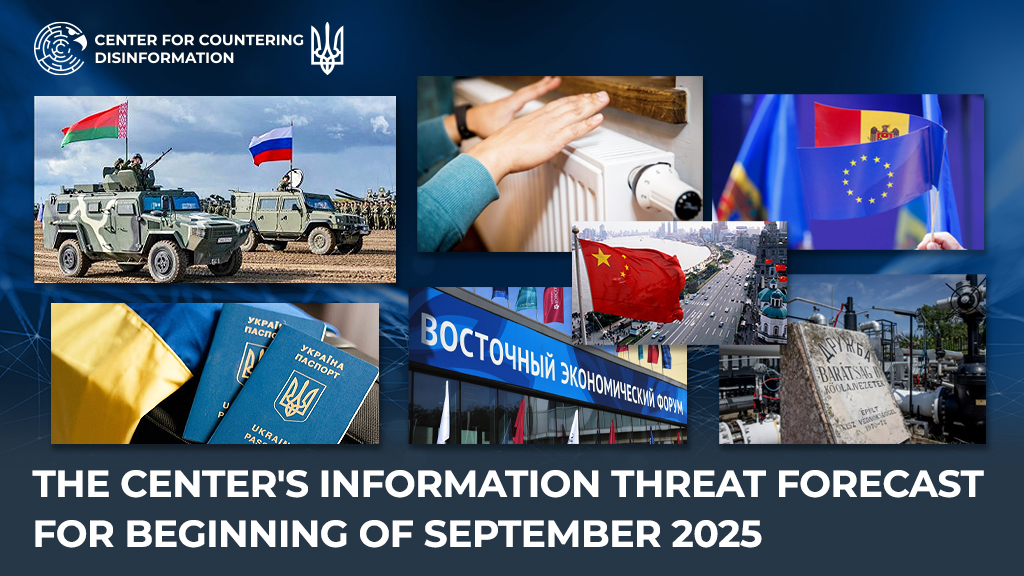
The Center’s Information Threat Forecast For Beginning of September 2025
1. Discrediting Security Guarantees and the Negotiation Process
The Center forecasts an intensification of campaigns aimed at discrediting security guarantees for Ukraine and the negotiation process, aimed at undermining trust in international support for Ukraine. russia will disseminate narratives about the alleged ineffectiveness and “fictitious” nature of Western guarantees, as well as about supposed disagreements between Ukraine and its partners, portraying the negotiation process as a tool to pressure Kyiv and force Ukraine into unfavorable compromises. Particular attention will be given to messages about Ukraine’s alleged “lack of agency” in the negotiation process and the decline of support from the U.S. and EU, intended to increase internal pressure on the Ukrainian authorities and undermine international solidarity with Kyiv.
Considering the “coalition of the willing” format, actively discussed among Western allies as a mechanism for security guarantees for Ukraine, russian propaganda will target the discrediting of this initiative. kremlin propagandists will spread disinformation about alleged internal disagreements among coalition participants, the artificial nature of the format, dependence on the U.S., and the absence of effective commitments. At the same time, propaganda will attempt to create the impression that the coalition is merely formal and incapable of providing real protection for Ukraine against potential aggression, and to foster distrust toward international support mechanisms. Messages will also be spread in countries participating in the “coalition of the willing” to provoke public opposition to the initiative and weaken support for Ukraine in general.
Another factor of information pressure will be the proposal of Italian Prime Minister Giorgia Meloni regarding security guarantees modeled on NATO’s Article 5. russian propaganda will manipulate the idea of “simulated” security, doubt the mechanism’s ability to genuinely protect Ukraine, and emphasize difficulties in coordination among European partners. Attempts to discredit this format will be organically linked to attacks on the “coalition of the willing” to sow doubts about the reliability of international support and deteriorate public sentiment regarding the negotiation process.
2. “West-2025” Training in belarus and Related Manipulations
It is forecasted that the “West-2025” training in belarus will be accompanied by a large-scale information campaign by russia and the lukashenko regime. The active phase of the exercises will take place from September 12 to 16. The main focus will be on stirring fear of a potential new invasion from the north: propaganda resources will disseminate messages about alleged troop deployments, the positioning of airborne assault brigades, and preparations for strikes against Ukraine. These claims are not confirmed by the actual situation at the border but aim to create an atmosphere of panic and uncertainty in Ukrainian society.
Simultaneously, the kremlin and minsk will promote narratives about the “exhaustion of Ukrainian Armed Forces resources” and Ukraine’s inability to resist the opening of a new front. Through fake expert comments and staged materials on social media, the thesis of the “inevitability of defeat” is spread to demoralize Ukrainians and undermine confidence in their own forces.
The information campaign is also aimed at Western audiences: the exercises are presented as a “demonstration of strength” by russia and belarus and as NATO’s “inability” to ensure Europe’s security without the kremlin.
A separate focus will be spreading rumors on social media about potential missile strikes from belarusian territory, border closures, or mobilization, designed to provoke panic. Additionally, the kremlin uses the exercises to discredit the belarusian opposition, accusing it of “supporting Ukraine” and “provoking war.” All of these are elements of a comprehensive information-psychological operation aimed at destabilizing Ukraine’s rear and undermining international support.
3. Campaign to Discredit the Ukrainian Government’s Decision on Youth Travel Abroad
The Center forecasts the continuation of a russian information campaign aimed at discrediting the Ukrainian government’s decision allowing youth aged 18–22 to travel abroad. A key element will be the creation of an impression of an alleged “mass exodus” of Ukrainian young men who supposedly do not plan to return, presented as evidence of demographic and social crises in the country. To this end, videos from border crossing points, out-of-context comments from individuals, and manipulative stories about avoiding military service will be actively disseminated.
russian propaganda will seek to form a narrative about the alleged “decline of Ukrainian society” and the supposed inability of authorities to maintain control over social processes. Emphasis will be placed on the thesis that the travel permission is not a concern for youth welfare but a measure to “save the authorities from protests.”
4. Campaign on “Mass Repressions in Ukraine”
An intensification of the russian disinformation campaign about alleged “mass political repressions in Ukraine” is forecasted. The main goal is to discredit the Ukrainian state, create the illusion of dictatorship and systematic human rights violations, and pressure international institutions to reduce support for Kyiv.
It is expected that statements and “declarations” from moscow-controlled structures will be disseminated. False large figures of “political prisoners” allegedly held in Ukraine will be injected into the information space using unverifiable or falsified examples. russian propaganda will promote messages about the persecution of journalists, clergy, and citizens for alleged “incorrect views” to create the impression of mass punitive policy by the Ukrainian authorities.
A separate instrument will be the campaign to compile so-called “lists of political prisoners,” which will be sent to world leaders and international organizations. The idea is to create the appearance of broad international concern over the situation in Ukraine. To legitimize these fake materials, known pro-russian media figures and moscow-controlled “experts” will be used. Through such information attacks, russia will attempt to portray Ukraine as a repressive state allegedly losing its democratic character and undeserving of Western support.
5. Campaign to Promote Anti-Ukrainian Sentiments in Poland
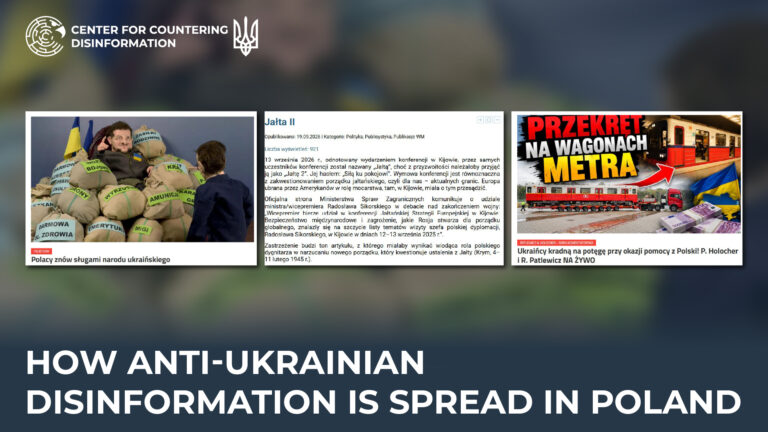
The Center forecasts the intensification of the russian information campaign aimed at spreading anti-Ukrainian sentiments in Polish society. russian propagandists will use a wide range of tools—from fakes and manipulations on social media to conspiracy theories and historical falsifications—to incite hostility between Ukrainians and Poles and undermine political and social support for Kyiv in this country. Particular emphasis will be placed on narratives about alleged “aggressiveness” of Ukrainians, their “high criminality,” and “excessive social benefits,” which could worsen the perception of Ukrainian refugees and migrants in Poland.
In particular, russian intelligence may organize the dissemination of pro-russian narratives through Polish-language Telegram channels and internet resources that position themselves as local news outlets but essentially post content from russian media blocked in the EU. The spread of fakes about alleged causes of acute conflicts, crimes, provocations, and the discrediting of Ukrainians in Poland is also possible. Underground campaigns may manipulate historical events to cool Polish-Ukrainian relations, as part of russia’s broader strategy to weaken unity in Central Europe.
These campaigns may also be accompanied by disinformation about Poland’s preparation of provocations, including regarding joint russian-belarusian military exercises in belarus, which will create additional tension in the region. russian information attacks may aim to exacerbate fears, interfere in Poland’s internal politics, strengthen anti-Ukrainian sentiments among Poles, and spread distrust between neighboring nations to destabilize the security environment in Europe.
6. Exacerbation of Fears Regarding Potential Heating and Energy Problems in Winter
From September, a gradual intensification of russian propaganda campaigns aimed at spreading fears related to the approaching cold season is expected. The main focus may be on energy security, damaged infrastructure, rising tariffs, and potential mass power and heating outages. The goal of such messages is to undermine trust in the state’s ability to ensure a stable heating season and to create an atmosphere of fear.
Mass dissemination of stories about an alleged “inevitable utility catastrophe” is expected, with figures about hundreds of thousands of people without heating in major cities. An additional block will be manipulations related to tariffs.
At the international level, narratives about an alleged “energy collapse in Ukraine” that could lead to “a new wave of refugees to Europe” are forecasted. This aims to increase pressure on Western governments and stimulate discussion about Ukraine’s vulnerability in winter. russia will attempt to use this information background to portray Ukrainian authorities as incapable and simultaneously discredit partner assistance, which is allegedly unable to resolve the situation.
7. Campaign on “Ukrainian Terrorism” in the Context of Strikes on the “Druzhba” Oil Pipeline
The Center forecasts the deployment of a large-scale russian information campaign promoting the narrative of “Ukrainian terrorism” in the context of strikes on the “Druzhba” oil pipeline. The main goal of this campaign is to portray Ukraine as a threat to Europe’s energy security, raise doubts about Kyiv’s reliability as a partner, and create the image of a “terrorist state.” Active dissemination of corresponding statements by russian diplomats, politicians, and affiliated experts is expected, along with the retransmission of statements from certain European politicians.
The campaign also aims to impose the perception that Ukrainian government actions harm Ukraine itself. russian media and affiliated resources will spread messages about potential fuel shortages, disruptions in electricity supply, and loss of partners due to Kyiv’s “ill-considered actions.”
Overall, the information operation will target multiple audiences simultaneously: internationally, to generate distrust toward Ukraine and undermine EU and NATO solidarity; domestically, to increase the sense of vulnerability regarding energy security.
8. Propaganda Surrounding the Eastern Economic Forum-2025
russian propaganda is expected to actively use the Eastern Economic Forum-2025, scheduled for September 3–6 in vladivostok. The main message will be the demonstration of alleged broad international support and successful development of russia’s foreign relations despite sanctions and political isolation. The forum will be presented as a platform gathering delegations from dozens of countries, high-ranking politicians, and businesspeople, and will be used to promote the thesis of “normalization” of world relations with moscow.
Propaganda is expected to focus on the scale of the event, the number of participants, agreements signed, and international initiatives. Messages will actively claim that russia is allegedly an important center of influence in the Asia-Pacific region. In this context, the forum will be positioned as an alternative to Western economic platforms and as proof that the world order can be shaped without the U.S. and EU.
Propagandists will attempt to create an image of multifaceted international dialogue, with russia acting as the initiator of a “unifying agenda” and the main driver of cooperation among countries in Asia, Africa, and Latin America. Additionally, attention will be drawn to economic agreements and projects allegedly guaranteeing russia development prospects even under Western sanctions.
Attempts are also expected to use the forum to promote narratives about the alleged inefficiency of Western sanctions, rapid growth of the russian economy and living standards, and supposed major opportunities for further development through cooperation with Global South countries.
9. Escalation of Information Campaigns Ahead of Elections in Moldova and the Czech Republic
Ahead of the elections in Moldova (September 28) and the Czech Republic (October 3–4), an intensification of the russian information campaign aimed at fostering political instability and discrediting pro-European forces is expected. In Moldova, the kremlin will increase support for pro-russian political forces and strengthen influence among the diaspora, particularly through the “Matryoshka” disinformation network, which will spread fakes and manipulations to demobilize voters and undermine the legitimacy of upcoming elections. russian propaganda will emphasize accusations of “external control” by Western powers, the country’s involvement in NATO, and “sending mercenaries to the war in Ukraine,” as well as “falsifying” election results, creating a basis for further interference and destabilization.
The kremlin will pay particular attention to influencing the Moldovan diaspora abroad, which holds significant political weight. russian propaganda networks will attempt to provoke division within Moldovan communities, spreading messages urging some diaspora members to abstain from voting or support pro-russian forces under the guise of fake “pro-European” politicians. The aim is to weaken the diaspora’s political influence, reduce its consolidated support for the country’s pro-European course, and contribute to internal political destabilization in Moldova.
In the Czech Republic, an increase in anti-Ukrainian propaganda in media and social networks is possible, particularly through the activities of pro-russian platforms and media companies spreading fakes about corruption in Ukraine, the futility of Western aid, and the discrediting of Ukrainian authorities. These campaigns aim to worsen Czech public perception of Ukraine and delay support for the country’s EU integration. Emphasis will be placed on corruption, misuse of aid, and portraying Ukraine as dependent on the West and a corrupt regime. Propaganda will also promote narratives about russia as a protector and peacemaker in the conflict, further complicating public discourse during elections.
10. Parade in Beijing and Related Manipulations
On September 3, 2025, a large-scale military parade will take place in Beijing, dedicated to the 80th anniversary of Japan’s surrender in World War II, which russia will attempt to use as a major diplomatic platform. vladimir putin will participate in the parade. The Center forecasts that the kremlin will seek to demonstrate that despite the war against Ukraine and sanctions, russia remains an influential international actor capable of participating in the largest global events alongside China.
The joint appearance of putin with North Korean leader Kim Jong Un and belarusian dictator alexander lukashenko alongside Xi Jinping will be an opportunity for russian propaganda to demonstrate alleged significant geopolitical influence of russia and its allies in the region and globally, emphasizing military capabilities that could shift the balance of power. The russian authorities will use this event to demonstrate the supposed “unity of the anti-Western camp” and promote messages about moscow’s alleged leading role in shaping a “new world architecture.” The kremlin will aim to present itself not as an isolated aggressor but as an “equal partner of China” and a center of power for countries opposing Western policy.
russian propaganda will actively emphasize putin’s presence in Beijing to legitimize his status domestically and show russian society that “moscow is not isolated,” similar to the May 9 parade. At the same time, the parade will serve as a tool to strengthen political and economic ties with countries ready to support or tolerate russia’s aggressive policies. Thus, for russia, this event will have primary significance not so much in the military but in the informational and diplomatic sphere.