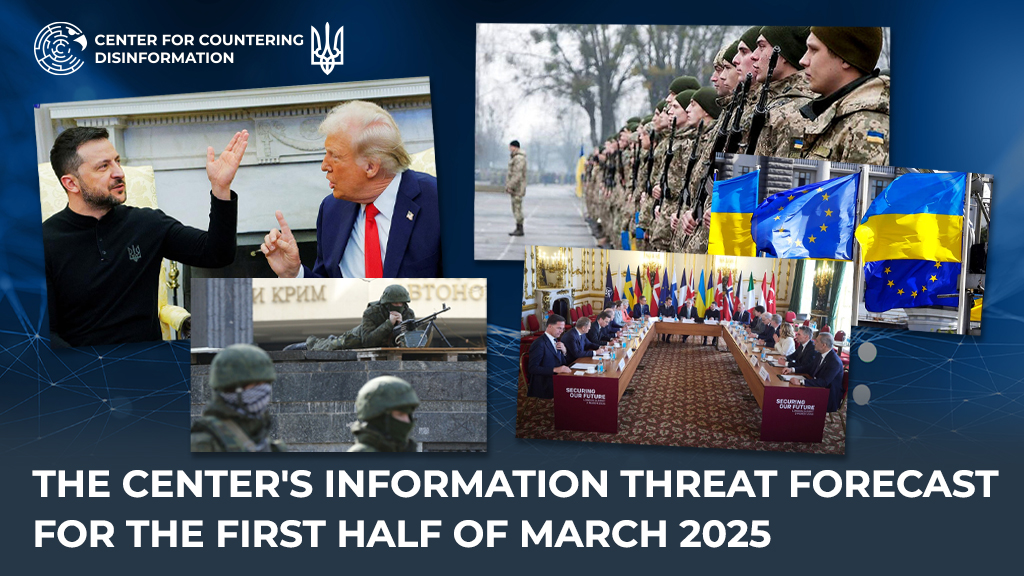
The Center’s Information Threat Forecast For the beginning of March 2025
1. Disinformation campaigns aimed at discrediting ukraine’s mobilisation process
russian propaganda is actively spreading disinformation and manipulative messages about mobilisation in Ukraine, using social media to disseminate fake videos and messages, manipulate information, and distort facts. The Center forecasts an intensification of this campaign on social media, particularly on X, primarily in English, targeting audiences in the USA and other Western countries.
Manipulative and disinformation messages regarding mobilisation aim to create an illusion for Western societies, especially in the USA, that Ukraine is a “non-democratic state,” where “human rights are violated,” “Ukrainians do not support the current government’s policies,” and “are ready for peace at any cost.” By promoting these narratives, the enemy seeks to discredit the Ukrainian government in the eyes of American society, halt military assistance to Ukraine, and pressure Washington into accepting all kremlin demands.
2. Escalation of disinformation campaigns to disrupt peace negotiations
The Center predicts an increase in russian propaganda campaigns aimed at disrupting or discrediting potential peace negotiations. The enemy’s primary efforts will focus on pushing the narrative that Ukraine is unwilling to negotiate and seeks to prolong the war.
The enemy’s propaganda machine will attempt to weaken international support for Ukraine, thereby giving the kremlin more opportunities to advance its own negotiation proposals.
An escalation of information operations in this area is expected both inside Ukraine and in Western countries. The enemy will attempt to sow chaos, uncertainty, and division within Ukrainian society—particularly between military personnel and civilians, as well as between the government and the public.
To achieve this, russian propaganda may intensify efforts to discredit servicemen and mobilisation processes, while also pushing narratives about the “illegitimacy” of the government. Specifically, messages will suggest that the government seeks to prolong the war to avoid elections and retain power for as long as possible.
Additionally, rhetoric may escalate claiming that Ukraine is unnecessarily prolonging the war, and that the conflict could have been resolved earlier through the so-called Istanbul agreements.
For Western audiences, narratives will be promoted claiming that military aid to Ukraine is a financial burden for partner countries and that they should accept Russia’s terms while it is supposedly ready for compromises.
There may also be an intensification of messages portraying Ukraine as “untrustworthy”, reinforced by staged “terrorist attacks” similar to the Marseille incident. At the same time, fake reports about “atrocities committed by the Ukrainian Armed Forces” are expected to continue spreading, aiming to discredit Ukraine in the eyes of Western societies.
By doing so, the enemy seeks to portray Ukraine as a “terrorist state” with which negotiations cannot be conducted.
3. Manipulations surrounding US-Ukraine relations and the outcomes of President Zelenskyy’s visit to Washington on 28 February
It is expected that russian propaganda will intensify the dissemination of manipulative and disinformation narratives suggesting that the United States has become completely disillusioned with Ukraine, all assistance will be halted, and the current White House administration sympathises with vladimir putin and russia, seeking to restore relations with moscow at any cost.
At the same time, an increase in russian propaganda targeting American audiences is expected, with messages aimed at discrediting Ukraine and its political leadership. These messages will focus on alleged:
“Illegitimacy” and “non-democratic nature” of the Ukrainian government
“Human rights violations in Ukraine”
“Persecution of Orthodox Christianity by the Ukrainian authorities”
A separate disinformation campaign targeting the US audience will focus on allegations of “misuse of American aid” and “total corruption within the Ukrainian government.”
The goal of these efforts is to sever the strategic partnership between Ukraine and the USA, drive a wedge between the US and the EU, halt military aid, and undermine diplomatic support for Ukraine.
4. Intensification of russian propaganda ahead of the anniversary of the attempted illegal legitimisation of Crimea’s military occupation (18 March)
As the anniversary of russia’s attempted illegal legitimisation of Crimea’s military occupation approaches, propaganda narratives traditionally intensify. The enemy seeks to justify the occupation of Ukrainian territories and create an illusion of the peninsula’s “prosperity” under russian administration.
russian propaganda is expected to promote narratives about “historical justice” and the “bloodless return of Crimea to its rightful harbour.” There will likely be an increase in propaganda materials in Crimean media about the “economic success” of the occupied peninsula and an improved standard of living for Crimean residents. These narratives will also be reinforced through mass events involving public sector workers, schoolchildren, and university students.
There may also be an intensification of rhetoric from representatives of Crimea’s occupation authorities about an alleged threat from Ukraine, used to justify the militarisation of the peninsula and turn Crimean residents against Ukraine.
5. Discreditation of the discussion on the presence of an international peacekeeping contingent in Ukraine
russian propaganda is expected to intensify efforts to discredit the idea of deploying a European peacekeeping contingent in Ukraine. The enemy’s main narratives include:
Foreign troops will allegedly escalate the conflict
Doubts about the neutrality of peacekeeping forces
The deployment of peacekeepers constitutes “external interference” in the conflict
russian propagandists will also appeal to “historical experience,” particularly from the Yugoslav wars, claiming that peacekeepers will only freeze the conflict rather than fully resolve it. Additionally, disinformation messages may be spread suggesting that the presence of foreign troops in Ukraine would lead to a loss of its sovereignty.
russia’s primary goal is to prevent any possibility of deploying an international military contingent to Ukraine, which could restrict russian forces’ freedom of action and improve the security situation in Ukraine.
6. Discreditation of Ukrainian-Turkish relations in the context of discussions about Ankara’s potential role in the negotiation process
Amid discussions about Turkey’s role as a security guarantor for Ukraine and its potential participation in organising peace negotiations, russian propaganda will seek to discredit Ukrainian-Turkish cooperation and undermine trust between Kyiv and Ankara.
Disinformation messages are likely to be promoted, alleging that cooperation with Ukraine harms Turkey’s interests and risks “dragging Ankara into the war.” For Ukrainian audiences, russian propaganda may push the narrative that Turkey is acting solely out of self-interest, and that Ukrainians will ultimately have to pay a high price for Ankara’s support.
7. Manipulations surrounding military support for Ukraine from partners amid EU leaders’ meetings
The Center predicts that russia will likely attempt to exploit meetings of European Union leaders, including the London summit on European security (2 March) and the extraordinary EU summit on Ukraine (6 March), to create an illusion of division among European countries and undermine Ukrainians’ confidence in continued European support.
Enemy propaganda may intensify messages about an “inevitable compromise with russia” and the “impossibility of further military aid” due to an alleged lack of unity among European states on these matters. Additionally, information influence operations within Europe may escalate, aiming to create divisions both within individual countries and among EU member states.
russian propaganda will traditionally attempt to use right-wing populist movements in Europe to spread these narratives.
8. Disinformation campaigns in Romania amid presidential elections
The first round of Romania’s presidential elections is scheduled for 4 May. The Center predicts an intensification of disinformation campaigns following the arrest of politician Călin Georgescu. russia may use this event to spread false narratives aimed at destabilising the situation.
russian propaganda is likely to portray the investigation and legal actions against Georgescu as “political persecution” and a “violation of freedom of speech.”
Additionally, russian propaganda may promote narratives aimed at destabilising Romania’s internal situation and stirring social unrest. On the international stage, russia may spread manipulations claiming that NATO countries are repressing “peace-oriented politicians” to continue aggressive anti-russian policies without obstruction.
9. Disinformation campaigns in Poland during the presidential elections
The first round of Poland’s presidential elections is scheduled for 18 May. The Center forecasts an intensification of disinformation campaigns in the country, aimed at dividing society and weakening support for Ukraine.
It is likely that russian propaganda will disseminate messages about “Ukrainians taking jobs, social benefits, and housing from Poles,” as well as fake reports about crimes allegedly committed by Ukrainian refugees. Additionally, manipulative claims may emerge suggesting that Ukrainian farmers are flooding the Polish market with cheap products, leaving Polish farmers unemployed.
Furthermore, russia will provoke conflict between Poland and Ukraine by exploiting historical issues, such as the Volyn tragedy, or by spreading manipulative claims about “Ukrainian territorial claims” on Poland. There is also a possibility that false narratives about Poland being “dragged into the war” through arms supplies to Ukraine will be actively promoted.
To execute these disinformation campaigns, russia will use social media, where fake accounts will amplify these narratives. It is also possible that certain public figures and even some Polish politicians may be involved in spreading russian disinformation.
10. Intensification of pro-russian forces in Moldova and threats from the unrecognised Transnistrian region
Parliamentary elections are scheduled to take place in Moldova in July. The Center forecasts that russia will increase its focus on the issue of the unrecognised “Transnistrian moldavian republic” and ramp up the activities of pro-russian politicians in Moldova.
Potential provocations may be aimed at accusing Ukraine of “terrorism” against the “authorities of Transnistria,” as well as amplifying russian propaganda narratives about Moldova allegedly seeking to join the “post-war partition of Ukraine”.
Amidst the pre-election climate, statements from Moldovan pro-russian politicians have already begun spreading. For instance, former Moldovan President Igor Dodon recently made a statement asserting territorial claims against Ukraine, referring to Moldovan citizens on Ukrainian territory who “are not being protected,” and hinting at a “new round of conflict in Transnistria.” Similar statements and narratives are expected to increase in the near future.
11. Intensification of foreign visits by russian officials
Amid the beginning of negotiations between the USA and russia, russian diplomatic institutions have visibly intensified their activities, particularly in Global South countries. There has been a noticeable increase in foreign visits by russian foreign minister sergey lavrov, secretary of the russian security council sergey shoigu, deputy chairman of the security council dmitry medvedev, and other officials.
The Center predicts that russian propaganda will use these visits to craft an image of russia as a “non-isolated state” that holds “great global influence,” consistently advocates for a “just multipolar world order,” seeks a “long-term peace in Ukraine,” and “cooperates with other nations based on equality and mutual respect.” Propaganda efforts will also attempt to exploit diplomatic statements made by foreign leaders to reinforce these narratives.
Additionally, russian diplomats are expected to escalate manipulations and speculations around the theme of “Western neocolonialism,” highlighting alleged injustices by the “golden billion” nations against the “Third World.” russian propaganda and diplomats will actively promote anti-Western stereotypes in Global South societies, using “russian Houses,” kremlin-controlled NGOs, and other so-called “non-political” structures abroad.
At the same time, Russia’s full-scale invasion of Ukraine will be portrayed as having been “provoked by the West,” while some international security initiatives related to Ukraine may be framed as attempts by certain global actors to disrupt the peace process.