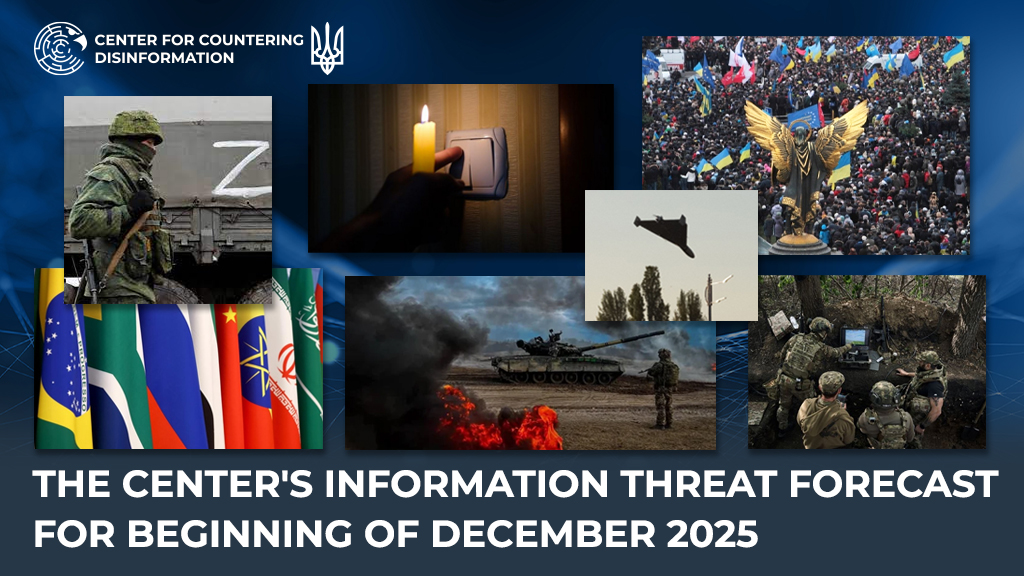
The Center’s Information Threat Forecast For Beginning of December 2025
1. Continued Disinformation Campaign Surrounding Negotiations to End the War
In the first half of December, the kremlin is expected to intensify its disinformation campaign around ongoing discussions on a diplomatic settlement of russia’s war against Ukraine. russia’s propaganda efforts will primarily focus on discrediting the negotiation process between Ukraine and the United States, attempting to advance the narrative that “Ukraine is sabotaging the talks because it does not want to end the war.”
In parallel, russia will likely seek to undermine EU diplomacy by promoting claims that “Europe is unwilling to end the war,” and by attempting to push European partners out of the negotiation process.
At the same time, moscow will likely continue avoiding transparent communication regarding the U.S. peace proposals, creating an information vacuum that enables manipulation of public sentiment both within russia and in Western countries.
A separate vector will involve information provocations — the dissemination through media of contradictory messages, alleged “insider leaks,” and fabricated stories designed to discredit diplomatic efforts by Washington, Kyiv, and European states. Such operations aim to sow distrust in the negotiations, create an impression of disorder in U.S. and allied policy, and undermine their credibility.
Simultaneously, russia is expected to push narratives aimed at demoralizing Ukrainian society. Pro-russian platforms will promote messages about “U.S. and European pressure on Kyiv,” “unfavorable conditions for Ukraine,” and Ukraine’s allegedly “weak” negotiating position. These narratives are intended to erode trust in Ukrainian authorities and shape a public perception of the supposed inevitability of russia’s preferred scenario.
2. Intensifying Fear-mongering Regarding the Situation on the Frontline
The Center forecasts that russia will scale up information operations aimed at portraying the situation on the frontline as allegedly “catastrophic” for Ukraine. kremlin propaganda will exaggerate the successes of russian forces and fabricate “victorious” battlefield reports. This information pressure seeks to instill a sense of Ukraine’s inevitable defeat and weaken societal resilience.
In addition, russia is expected to activate information operations targeting Ukrainian audiences directly. This may include mass dissemination of AI-generated videos depicting a “collapse of defenses” or “panic on the frontline,” accompanied by increased activity of russia-controlled platforms disguised as Ukrainian sources. These channels may spread panic-inducing messages and calls for political decisions favorable to the kremlin.
russia will likely push similar narratives toward Western audiences, promoting claims about the “critical condition of the Ukrainian military” and the alleged “futility of continued support for Kyiv.” This aims to shape public opinion in partner countries, particularly amid ongoing diplomatic developments.
3. Manipulations Concerning the State of Ukraine’s Energy System
With the onset of winter, russia is expected to intensify information operations aimed at fueling fears about the state of Ukraine’s energy system. The core narrative will be the shifting of responsibility for energy challenges onto the Ukrainian government and individual officials. russian media will attempt to portray the Ukrainian authorities as “incompetent,” reinforcing the claim that “Ukraine is unable to ensure energy stability.”
Through this information noise, russia seeks to redirect public frustration over prolonged power outages toward Ukrainian leadership, diverting attention from the root cause — russia’s targeted attacks on Ukraine’s energy infrastructure.
At the same time, information pressure on Europe may also increase. russian propaganda could renew narratives about the “harmfulness” of Europe’s refusal to use russian energy carriers, including the recurring claim that “Europe will freeze without russian gas.”
4. Disinformation Campaign Following russian Drone Intrusions into Moldova and Romania
Following the intrusion of russian drones into the airspace of Romania and Moldova, russian propaganda launched a disinformation campaign aimed at shifting responsibility for these incidents onto Ukraine. The Center forecasts that this campaign will continue into December. Already, fake reports are circulating about an alleged Ukrainian drone crash on Romanian territory, and further provocations by russia within this narrative framework are likely.
Through such actions, russia seeks to create the false impression that Ukrainian drones — not russian ones — are attacking European states. The objective is to discredit Ukraine and undermine trust among its partners. Similar tactics were used by russia after previous incidents involving strikes in Poland, where moscow spread fake information to fabricate the illusion of Ukrainian responsibility.
New provocations involving russian drones or aircraft in NATO airspace cannot be ruled out, as well as other actions intended to intimidate populations in those countries and destabilize their domestic political environments.
5. Revival of Pro-russian Narratives About the Euromaidan
The Center forecasts that in the first half of December, russian propaganda will intensify its efforts to discredit the events of the Revolution of Dignity, leveraging the anniversaries of key episodes — the March of Millions (1 December), the dismantling of the lenin monument (8 December), and the violent attempts to clear the Maidan (9–11 December). The kremlin traditionally uses these dates to reiterate its manipulative interpretations of the Revolution of Dignity and to amplify fabricated historical narratives.
russian propaganda consistently exploits the Euromaidan events to promote the narrative of an alleged “Western-orchestrated coup.” Ukrainian protests are portrayed as an “artificial uprising,” a “color revolution” engineered by the U.S. and EU to install a “controlled regime” in Kyiv. In this framing, the Maidan is depicted not as a civic response to state violence, corruption, and the rejection of European integration, but as the result of a supposed “Western intelligence conspiracy” that allegedly “funded the protests,” “directed opposition leaders,” and “interfered in Ukraine’s internal affairs.”
In parallel, the kremlin continues to amplify its long-standing narrative of a so-called “fascist coup” and “radical takeover.” russian media have systematically labelled Euromaidan protesters as “nazis,” “far-right radicals,” and “banderites,” while branding the post-Maidan government as an “illegitimate Kyiv regime.” This narrative complex includes fabricated claims about the “ban on the russian language at the Maidan,” myths about a “civil war provoked by nationalists,” and accusations that Maidan allegedly “triggered the loss of Crimea and Donbas.” Through these narratives, the kremlin seeks to deny the agency of Ukrainian society and justify its own aggression as a “response to a coup.”
6. Use of the BRICS+ Counterterrorism Conference to Advance russia’s Propaganda and Political Influence in the Global South
On 3–4 December, moscow will host the BRICS+ Counterterrorism Conference under the auspices of russia’s foreign ministry, with announced participation from relevant government agencies, experts from the UN, CIS, SCO, CSTO, and scholars specializing in counterterrorism and anti-extremism. The Center forecasts that russia will use this event to promote narratives about its alleged “special role” in global security and to legitimize its own approaches to counterterrorism through international platforms.
Expected messaging includes calls for a “joint fight against Western disinformation,” accusations that the U.S. and EU “use terrorist methods to pressure independent states,” as well as claims about “links between Ukrainian structures and extremist groups.” These communications will aim to build russia’s international image as a state supposedly “combating terrorism,” and to assemble a coalition of Global South countries willing to support kremlin-backed information initiatives.
At the same time, the kremlin may use the conference to promote its own “red lines” and justify repressive methods of information control by emphasizing threats from “undesirable organizations” or “foreign influence.” This strategy aims to legitimize the tightening of internal censorship in russia and to secure international support for moscow’s information operations under the guise of counterterrorism.