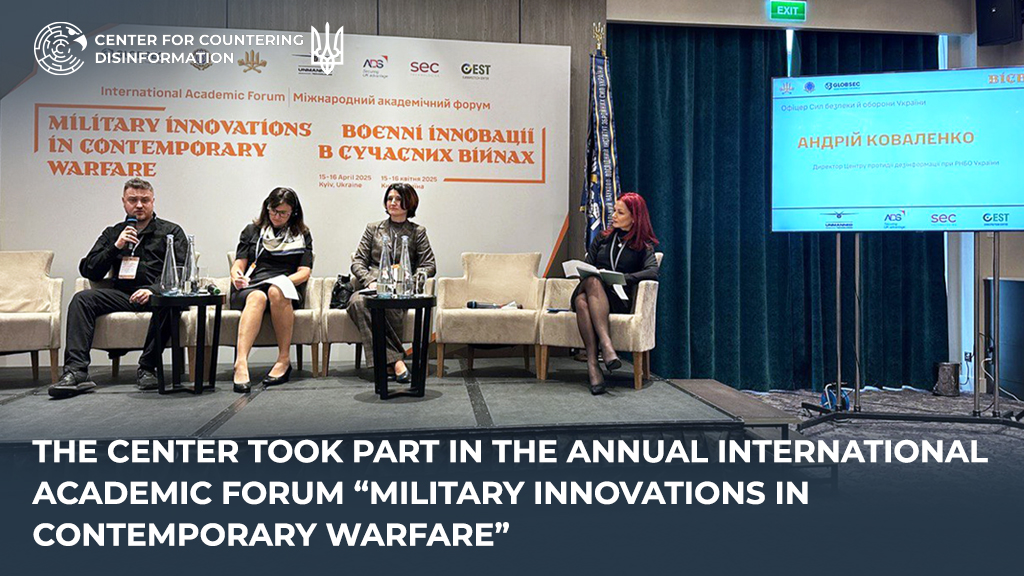
The Center took part in the annual International academic forum “Military Innovations in Contemporary Warfare”
On April 15, the Head of the Center for Countering Disinformation and officer of the Defense Forces of Ukraine, Andriy Kovalenko, took part in the annual International academic forum “Military Innovations in Contemporary Warfare.”
During the panel discussion titled “Contemporary asymmetric warfare forms and methods ,” Kovalenko emphasized that one of the key elements of hybrid aggression is cognitive warfare. He explained that contemporary wars are waged across three domains: traditional combat operations occur in the physical space, information campaigns unfold — in the media, and in the cognitive dimension —within ideology, culture, and personal worldviews — wars over meaning are fought, that are the most dangerous, as they influence generational consciousness and reshape beliefs and knowledge.
The Head of the Center pointed out that this form of warfare became especially threatening with the rise to power of vladimir putin in russia. According to him, the kremlin began actively investing in information and meaning-based operations, forming an entire industry of hostile messaging and propaganda.He also pointed out that a part of cognitive warfare, whose goal — to instill public despair and force people to abandon their territories, is the terror of civilians.
Andriy Kovalenko paid particular attention to the role of artificial intelligence, stressing that AI forms the foundation of many hostile information attacks. In the future, he stated, those states that learn to effectively develop and apply AI tools will gain a strategic advantage in the field of information security.
In Kovalenko’s view, the time has come to change the approach to countering disinformation at the European level, moving toward proactive, decisive, and mirrored actions not only within domestic information spaces but also on enemy territory. “The strategy of defense, the strategy of study is not quite successful. Europe needs to move to a strategy of offense. Ukraine is already doing it, but Europe is not. And this will end badly for the EU if approaches are not changed,” – he emphasized.
The discussion featured contributions from Sae Schatz, Executive Director of the Partnership for Peace Consortium at the George C. Marshall European Center for Security Studies; Josef Schroefl, Deputy Director for Strategy and Defense at the European Centre of Excellence for Countering Hybrid Threats; Ivana Stradner, Special Correspondent for KyivPost; Pete Apps, journalist at Inside Housing; Colonel Nataliia Semeniuk, representative of the Strategic Communications Directorate of the Office of the Commander-in-Chief of the Armed Forces of Ukraine, and others.