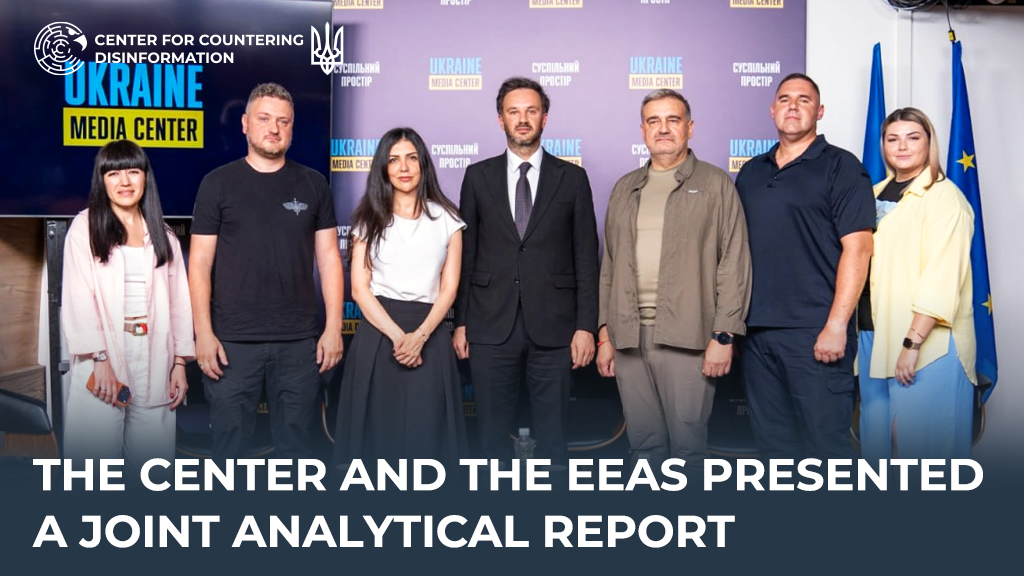
The Center and the EEAS presented a joint analytical report
On July 15, 2026, the Center for Countering Disinformation and the European External Action Service (EEAS) presented a joint analytical report titled “Beyond the Battlefield: Russia’s Information War Against Ukraine’s European Future.”
The study provides a detailed analysis of the architecture of the Kremlin’s propaganda apparatus, its infrastructure, and the key narratives that the enemy disseminates to both Ukrainian and European audiences. Analysts have exposed the tactics Russia uses to undermine confidence in reforms, sow division within the EU, and weaken international support for our country.
Andriy Kovalenko, head of the Center for Countering Disinformation and an officer in the Ukrainian Defense Forces, noted that Russia’s attempts to maintain influence over post-Soviet countries and European states are failing despite massive financial investments in propaganda. Therefore, the Kremlin is now making every effort to undermine support for Ukraine’s EU membership — both within Ukraine and in European countries.
Anayit Khoperia, Deputy Head of the Center for Countering Disinformation, said while presenting the report that from January 2025 to May 2026, the CCD identified 244,000 posts about Ukraine’s accession to the EU, which garnered 1.39 billion views. Of these, 2,660 sources showed signs of inauthentic behavior. The CCD documented not isolated cases of disinformation, but sustained and coordinated efforts by FIMI. It reported on four interconnected blocks of Russian FIMI activity aimed against Ukraine’s accession to the EU — techniques, tactics, networks, and procedures of influence — as well as the logic behind responding to Russian FIMI.
Representatives of Ukrainian government agencies also participated in the event, including the Main Intelligence Directorate of the Ministry of Defense of Ukraine, the Security Service of Ukraine, and the Ministry of Foreign Affairs of Ukraine.
Andriy Chernyak, a representative of the Main Intelligence Directorate of the Ministry of Defense of Ukraine, emphasized that obstructing Ukraine’s European integration process is one of the Russian Federation’s priorities; therefore, the Kremlin is actively spreading anti-Ukrainian narratives in EU countries using the latest technologies, particularly AI.
Oleksandr Melnychenko, a representative of the Security Service of Ukraine, reported on the SSU’s efforts to identify pro-Russian influence networks and individuals spreading hostile narratives, as well as funding channels and other related activities. He noted that the SSU, CCD, and the Ministry of Digital Transformation are collaborating with digital platforms to block harmful content.
Georgiy Tykhyi, spokesperson for the Ministry of Foreign Affairs of Ukraine, expressed the view that Russia will continue to intensify the spread of narratives aimed at provoking Euroskepticism and undermining Ukraine’s relations with its allies. Therefore, joint efforts by Ukraine and its partners to counter Russian FIMI are of the utmost importance.