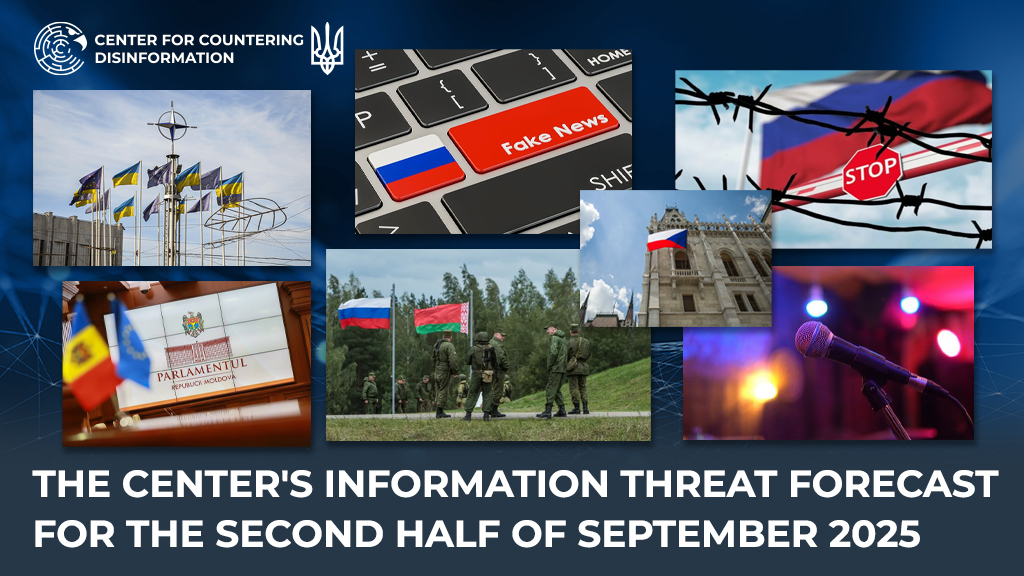
The Center’s Information Threat Forecast For the second half of September 2025
1. Continuation of Discrediting Security Guarantees for Ukraine
The Center predicts that russia will not ease its information attack on initiatives regarding international security guarantees for Ukraine. During the second half of September, kremlin propaganda will continue to push the idea of the “fictitiousness” of any Western security commitments to Kyiv. In particular, repeated statements are expected that without russia’s participation, any agreements on guarantees are “empty talk.” Propagandists and russian officials will claim that discussing security guarantees without moscow is a “road to nowhere,” hinting at the need to include russia as a guarantor on terms favorable to the kremlin. This message aims to undermine trust in the “coalition of the willing” format of Western states and justify russia’s ultimatums under the guise of concern for real security.
Another line of disinformation will involve manipulating examples of past promises to sow doubt about current ones. Narratives about “reduced support” from the US and EU will be promoted. Any delays or difficulties in implementing bilateral security agreements (for example, in ratifying treaties or allocating aid) will be presented as proof of the West’s unwillingness to truly defend Ukraine. Through russia-controlled media, messages suggesting that “Ukraine will be used and abandoned” will be spread to undermine Ukrainian citizens’ trust in allies and pressure the government into seeking compromises with russia.
2. Discrediting the EU’s 19th Sanctions Package and Coordination with the US
In the second half of September, preparations and implementation of the EU’s 19th sanctions package against russia, coordinated closely with Washington, are expected. The Center predicts that russian propaganda will aim to discredit both the document itself and the unity between the US and EU on the sanctions issue. kremlin propagandists will heavily promote the narrative of “Europe’s fatigue with sanctions” and claim that disagreements are growing among allies. Particular attention will be given to sensitive aspects of the 19th package, such as the possible inclusion of new russian banks or restrictions on third-country companies (China, India, etc.) for circumventing sanctions.
russia will present such decisions as proof that the US “dictates” terms to Europe, while some EU countries allegedly disagree and delay the package’s adoption. In addition, russian media will traditionally emphasize the “ineffectiveness” of all previous sanctions rounds, claiming that russia’s economy has “adapted and is growing” despite sanctions. Data on economic difficulties in Europe – rising prices, the energy crisis – will be manipulated to support the narrative that sanctions harm the EU more than russia.
In the information space, messages will be actively promoted that new sanctions are “useless” and only harm Europe while provoking conflict with important partners (e.g., China, which could face restrictions for cooperation with russia). The goal of this campaign is to sow doubt among the European public about the advisability of increasing sanctions pressure and to shake the resolve of Western elites in implementing the 19th package.
3. Completion of the “West-2025” Exercises in belarus and Border Tensions
The Center expects that after the active phase of the joint russian-belarusian “West-2025” exercises (held from September 12 to 16) ends, russian propaganda will continue to exploit these maneuvers for information pressure. The kremlin will present the exercise results as a “successful demonstration of the Union State’s power,” claiming that troops practiced hypothetical strikes on Ukraine and defense against NATO forces. Reports will continue to circulate about alleged NATO preparations for war against russia and the potential for a new offensive on Ukraine from belarus. These messages aim to justify russia’s policies to its own population, reference a perceived threat, psychologically pressure Ukrainian society and command, and force the retention of significant forces in the northern direction.
Propaganda outlets will emphasize that the West allegedly “feared” the exercises following russia’s attack on Poland on September 10. As “evidence,” they may cite Poland’s decision to temporarily close some border crossings during the maneuvers or increased border security by neighboring states, presenting it as a victory of russia’s intimidation strategy. Simultaneously, the kremlin will continue to push the narrative of the “exhaustion of Ukrainian Armed Forces resources,” claiming that Ukraine is so depleted that any new northern front would lead to its military collapse. Claims of a possible renewed invasion from belarus, missile strikes, or a new wave of mobilization in Belarus will continue even after the exercises end – aiming to maintain an atmosphere of fear and uncertainty. This information operation is designed to sustain tension in Ukraine’s border regions and pressure the West by demonstrating russia’s alleged constant readiness for escalation.
4. Campaign Following the Murder of Charlie Kirk
The Center predicts that russian propaganda will actively use the murder of American political activist Charlie Kirk to create a narrative about an alleged “Ukrainian trace” in the crime. The campaign’s main line is expected to be built around claims that Kirk’s death allegedly benefits Ukraine, as he repeatedly criticized Kyiv and condemned U.S. support for Ukraine. Propagandists will attempt to portray this crime as “revenge by Ukrainians.”
It is also expected that comparisons of Kirk’s murder with other attacks will be actively used. For example, media are already drawing parallels with the assassination attempt on Slovak Prime Minister Robert Fico; both are framed as “attacks on those who oppose aid to Ukraine.” In this way, russian propaganda will try to prove the existence of a “systematic campaign of terror” in which Kyiv plays a central role.
As part of the campaign, russian bot farms may also become more active, attempting to influence public opinion in the U.S. by promoting anti-Ukrainian narratives.
Ultimately, this campaign will have several objectives: to sow doubt in American society about Ukraine, intensify domestic political division in the U.S., portray Kyiv as a “dangerous” and “unreliable” partner, and reinforce russia’s image as a “victim of a global conspiracy.”
5. Manipulations During the UN General Assembly and International Day of Peace
On the eve of and during the high-level segment of the UN General Assembly, the Center predicts that russia will intensify its diplomatic and media campaign, pushing its own vision of “peaceful settlement.” The kremlin will use the UN podium to accuse the West of “unwillingness for peace.” Propaganda will place particular emphasis on September 21, the International Day of Peace: russian outlets will promote the thesis that only moscow seeks peace, while Kyiv and its allies “continue to escalate the conflict.” Statements from russian officials will be filled with rhetoric about the “neo-colonialism of the West” and calls for a “multipolar world,” aiming to gain support from Global South countries and divert attention from russia’s aggression.
Humanitarian issues may also be manipulated: the kremlin will blame the West’s sanctions policy for provoking a global food and energy crisis, promising to resolve these problems in exchange for concessions from Ukraine. All these actions aim to present russia as a “peaceful party,” shift responsibility for the continuation of the war onto Ukraine and its partners, and pressure the international community to push Kyiv into negotiations.
6. Propaganda Around the “intervision-2025” Contest in russia
On September 20 in moscow, on the eve of the Day of Peace, an international singing contest “intervision-2025” is scheduled, which the kremlin will attempt to exploit for propaganda purposes. The Center expects that the russian authorities will position the event as an alternative to Eurovision and as proof that the country is allegedly not isolated on the international stage. Propaganda will emphasize the wide geographic representation of participants: delegations from over 20 countries, including states from Asia, the Middle East, Africa, and Latin America. In this way, the kremlin will create the image of “global support” for russia, highlighting even the participation of representatives from some Western countries to show that attempts to isolate russia have failed.
The coverage of the contest will aim to elevate russia’s image as an influential center of world culture. Propaganda media will focus on the loudness and pomp of the show, the presence of foreign performers, and positive guest feedback – all presented as “normalization of relations” with russia despite sanctions and war. At the same time, the Eurovision format will be discredited: kremlin outlets will talk about its “politicization and russophobia,” while “intervision” will be presented as a unifying event that is “beyond politics.” The goal of this operation is to strengthen the internal audience’s belief that russia has not lost global connections and to promote abroad the narrative that many countries are willing to cooperate with russia in cultural and humanitarian spheres.
7. Manipulations Around the So-Called “Governor” Elections in Sevastopol
The illegal elections of the so-called “governor” in occupied Sevastopol (September 12-14) will serve as a tool for russian propaganda to legitimize the occupation of Crimea. The kremlin will actively use this event to demonstrate the alleged “normal functioning” of democratic processes in occupied territories and local support for the “russian authorities.” Particular emphasis will be placed on the implementation of electronic voting as an “innovative” and “transparent” mechanism.
kremlin-controlled media will spread stories about “mass participation” of residents in the electoral process and “high trust” in the russian authorities. At the same time, a campaign is expected to discredit international organizations that recognize these “elections” as illegal. Propaganda will attempt to portray any criticism as “interference in russia’s internal affairs” and “disregard for the will of Crimeans.” This event will also be used to further reinforce the narrative of Crimea’s “reunification” with russia.
8. Information Campaign Around Parliamentary Elections in the Czech Republic and Moldova
The Center predicts an intensification of the russian disinformation campaign around the parliamentary elections in the Czech Republic (October 3-4) and Moldova (September 28), aimed at discrediting pro-European forces and increasing political instability. In Moldova, the kremlin will focus on promoting the narrative of “state capture by Western forces” and supporting pro-russian candidates through the “Matryoshka” disinformation network. russian propaganda will attempt to create the impression of alleged “falsification of upcoming voting results” and external interference, serving as an informational basis for further destabilization. Additionally, the kremlin will actively use conspiracy narratives — for example, about alleged “Western plans to drag Moldova into a war in Transnistria” or “turning the country into a military hub for Ukraine.”
In the Czech Republic, an increase in anti-Ukrainian propaganda is expected through pro-russian media platforms spreading fakes about corruption in Ukraine, the inefficiency of Western aid, and discrediting the Ukrainian authorities. The main goal is to worsen Czech society’s attitude toward Ukraine and weaken support for its EU integration aspirations. Propaganda will also promote narratives portraying russia as a “protector and peacemaker” in the conflict, further complicating public discourse during the electoral campaign.
9. Continuation of the Campaign to Stir Anti-Ukrainian Sentiments in Poland
The Center predicts the intensification of the russian information campaign aimed at further stoking anti-Ukrainian sentiment in Polish society. In the second half of September, kremlin propagandists will increase their presence in the Polish-language information space — via anonymous Telegram channels, bot networks on social media, and websites — with the aim of sowing hostility between Poles and Ukrainians. Massive dissemination of fakes and manipulations is expected, including: accusations of Ukrainian refugees of criminality and extremism, scare stories about “Ukrainian sabotage” in Poland to draw the country into the war, and slanders about “excessive social benefits” for Ukrainians, allegedly burdening the Polish budget. Through such manipulations, the kremlin will attempt to generate fear, irritation, and resentment among Poles regarding the presence of Ukrainians.
In the information space, any statements or incidents that play into anti-Ukrainian rhetoric (from trade disputes to everyday conflicts involving refugees) will be highlighted. This comprehensive campaign aims to sow distrust between Ukrainians and Poles, undermine societal support for Ukraine in Poland, and complicate cooperation between the two countries, which is vital for countering russian aggression in the region.