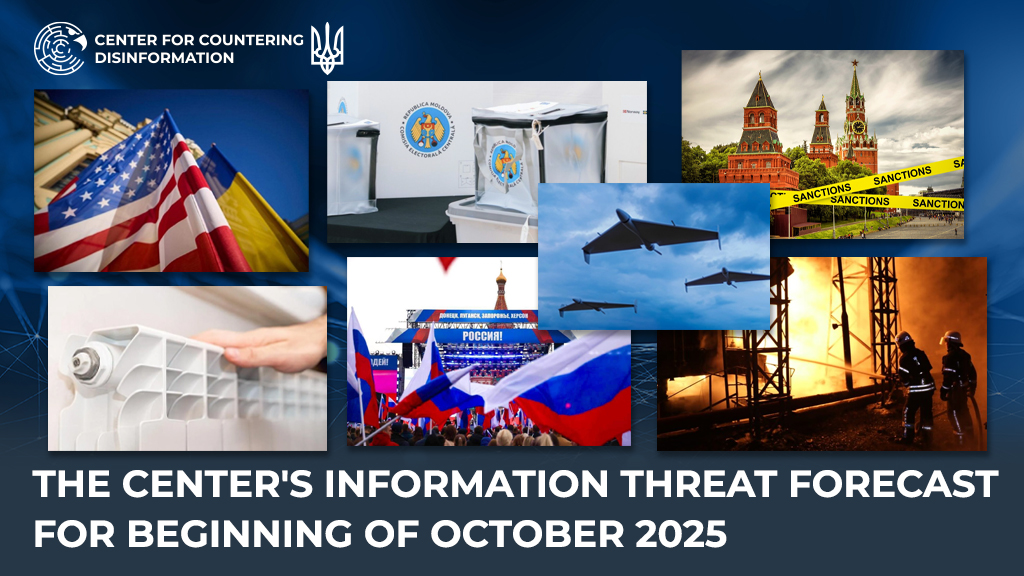
The Center’s Information Threat Forecast For Beginning of October 2025
1. Discrediting the Ukraine–U.S. Partnership After the Talks in New York
The Center forecasts that after the presidential talks in New York, kremlin and pro-kremlin media will intensify narratives about the alleged “withdrawal” of the U.S. from an active role in resolving the war — claiming that Washington has limited itself to selling weapons and has no intention of engaging in a political settlement.
Enemy propaganda will likely emphasize the alleged “uncertainty” or “restraint” of the U.S. to sow doubts about the partners’ ability to guarantee Ukraine’s security.
Simultaneously, the narrative that no settlement is possible without direct U.S. involvement will be promoted to shift responsibility for escalation onto Kyiv and its Western partners. The goal is to demoralize Ukrainian society, undermine hopes for a swift end to the war, and pressure the government to seek “compromises” with russia.
At the same time, an increase in russian narratives about an “aggressive Europe” allegedly seeking to continue the war “through Ukrainians” and “preparing to attack russia” is expected.
2. Manipulations Around Airspace Violations of European States
The Center forecasts that russian propaganda will exploit incidents involving violations of European airspace by drones or aircraft for information attacks. It is expected that the main narrative will focus on claims that European intelligence services are “exaggerating the threat” or “lack any evidence” of such violations. The emphasis will be on denying responsibility for provocations, shifting the blame onto Ukraine — alleging that drones entered Poland or Denmark due to Ukrainian electronic warfare systems — and discrediting NATO. These messages may range from claims about escalation risks caused by the “aggressive reaction of the Alliance” to narratives about a “split within NATO” and the bloc’s “inability to respond collectively.” kremlin-linked media will likely ridicule the concerns of EU governments, portraying them as “manifestations of russophobia.” These messages are designed to minimize reputational damage to moscow and create the impression that complaints about provocations are merely an excuse to “fuel anti-russian hysteria.”
At the same time, russian officials and media will promote the opposite narrative — portraying any European security measures as “threatening behavior toward russia.” They will spread claims about alleged “deployment of weapons and troops” near russian borders, among other narratives. In this way, the kremlin will seek to shift the focus — instead of justifying its own provocations, it will portray European countries as aggressors “sharpening their weapons” against russia.
Ultimately, this information campaign will pursue two main goals: to devalue the EU’s response to real violations and to shift responsibility for escalation onto European states, while reinforcing the belief within russia that it is “surrounded by enemies.”
3. Discrediting the Results of the Elections in Moldova and Destabilization
In the parliamentary elections, the party of incumbent President Maia Sandu, Action and Solidarity (Partidul Acțiune și Solidaritate, PAS), secured victory and significant public support.
It is expected that russia will intensify a comprehensive information operation aimed at discrediting the official election results and destabilizing the political situation in the country. A large-scale spread of accusations is anticipated, including claims of administrative resource abuse during the elections, vote falsification, discrimination against russian-speaking citizens, and Moldovan citizens residing in the russian federation. Hostile propaganda will likely seek to provoke division and internal conflict within Moldovan society. Additionally, accusations will be directed at Europe, alleging interference in Moldova’s internal affairs.
During these elections, the kremlin launched a large-scale disinformation network spreading fake news through social media, bot farms, and pro-russian media, focusing on discrediting the PAS party, portraying it as a “Western puppet” and “the cause of the country’s economic problems.”
In addition to information attacks, cases of financing pro-russian groups, voter bribery, protest organization, and election process sabotage — including provocations — were recorded. One of the kremlin’s main objectives is to create an artificial social divide and spread mass doubts about the legitimacy of the elections — paving the way for legal challenges to the results and further political destabilization of Moldova as a state pursuing a pro-European course.
4. Propaganda Campaign in the Temporarily Occupied Territories for the So-Called “Reunification Day”
Starting from September 30, russian propaganda is expected to intensify its information campaign marking the anniversary of the illegal annexation of the Donetsk, Luhansk, Kherson, and Zaporizhzhia regions — an event the kremlin refers to as the “day of reunification with russia.” The central message will remain the justification of armed aggression and the occupation of Ukrainian territories through the rhetoric of “saving” local residents. To reinforce this narrative, russian politicians and representatives of occupation administrations are expected to actively spread statements about allegedly “protecting the russian-speaking population from the threat coming from Kyiv.”
Another major direction will be a large-scale information campaign targeting residents of the occupied territories through media resources specifically created for these regions. The campaign will promote numerous manipulative reports about “reconstruction,” infrastructure development, and improvements in the social sector over the past three years. This presentation aims to create the illusion of “prosperity under russia” and distract attention from real humanitarian issues, including water shortages in Donetsk region and risks ahead of the heating season.
Mass events for this “holiday” are also expected, with the forced participation of children, students, and public sector employees under the guise of voluntary involvement. Such events will be used for visuals in russian media to showcase the allegedly “genuine support” of the population in the occupied territories for the decision to join the russian federation. In this way, the kremlin will seek to reinforce among both its domestic and local audiences the myth of “successful integration,” while continuing to justify the criminal occupation.
5. Information Attacks Amid the Start of the Heating Season
Before the start of the heating season, russian propaganda is likely to intensify an information campaign tentatively titled “Black Winter.” Against the backdrop of intensified strikes on energy and civilian infrastructure, the enemy will seek to fuel fears about the alleged inability of the Ukrainian government to ensure a proper start of the heating systems. Propagandists will spread narratives about a “catastrophe in the energy and utility sectors,” a “government-business conspiracy,” and “indifference of the authorities toward citizens.”
The main goal of this campaign is to spread panic among the population, discredit the Ukrainian leadership, and fuel protest sentiments. Any technical issues or local malfunctions in the energy system, including those caused by massive shelling, will be presented as a “systemic failure of the state.” Through social networks and pro-kremlin media, the narrative will be promoted that Ukrainians are allegedly “abandoned” as winter approaches.
In this way, the kremlin will attempt to exploit the seasonal vulnerability factor for information pressure — undermining public trust in the government and diverting attention from the real cause of the crisis phenomena: russian missile and drone attacks.
6. Intensification of the Disinformation Campaign on the Alleged Illegitimacy of the Ukrainian Government
On the last Sunday of October, October 29, 2025, regular local elections were scheduled to take place in Ukraine. Since these elections will not take place due to russia’s full-scale war and martial law, russian propaganda may use this date to intensify a disinformation campaign about the alleged illegitimacy of the Ukrainian government.
The spread of messages about the “illegitimacy” of the President of Ukraine, the Verkhovna Rada (the Parliament of Ukraine), and local authorities is expected, along with manipulations around the Constitution of Ukraine and accusations of “usurpation,” “lack of democracy,” and “establishment of a dictatorship.”
russian propaganda will likely focus its main attention on local self-government bodies, seeking to provoke division among Ukraine’s regions and destabilize relations between central and local authorities.
Against the backdrop of these messages, simultaneous pressure on Ukraine’s Western partners is expected — calling on them to “urge” Kyiv to resume the electoral process as soon as possible, using it as a tool to weaken Ukraine’s internal unity and political stability.
7. Justification of Attacks on Energy Infrastructure
The Center forecasts that in response to increased attacks on Ukraine’s energy infrastructure, kremlin media and russian officials will systematically justify these strikes, using several interrelated narratives. In particular, the attacks will be presented by ru-propaganda as “justified” strikes on allegedly military-strategic or “dual-use” facilities, which supposedly directly support Ukraine’s offensive capabilities or the delivery of Western weapons.
Simultaneously, a narrative will be promoted that the strikes on Ukraine’s energy infrastructure are allegedly a “response” to Ukrainian attacks on rf territory, supposedly a “necessary reaction to Ukrainian terrorism.” To advance this narrative, media will feature dramatic testimonies of affected russian civilians, while diplomatic channels will be used to broadcast these messages abroad. The goal of this coordination is to shift responsibility for the destruction of Ukraine’s civil infrastructure onto Ukraine itself and to reduce international condemnation of russian military strikes.
8. russian Hybrid Influence and Disinformation Ahead of Czech Parliamentary Elections
In the first half of October 2025, ahead of and during the Czech parliamentary elections on October 3-4, a significant intensification of russian hybrid influence is expected, aimed at destabilizing the situation, undermining citizens’ trust in state institutions, and weakening the country’s pro-European course.
The main tools of influence will include information campaigns spreading fakes and disinformation via social networks and pro-russian online resources, as well as promoting narratives of political forces opposing Czech membership in the EU and NATO or criticizing support for Ukraine. Particular emphasis will be on discrediting the ruling coalition, spreading claims of “betrayal of national interests” and alleged total dependence of the Czech Republic on Brussels and Washington.
The adversary will attempt to popularize messages about the “unfairness of the electoral system,” “financial crisis,” and “deep societal divide,” as well as try to organize online attacks on vote-counting platforms to create chaos and sow doubts about the legitimacy of results. A separate direction will be the support of political leaders and parties with openly populist rhetoric, linked to kremlin financial structures, including via the recently exposed Voice of Europe network, which funded pro-russian politicians and spread anti-Ukrainian propaganda. The emergence of fake news related to Ukrainian refugees, allegedly “negatively affecting social stability in the Czech Republic,” can also be expected. The main goal of kremlin actions is to demoralize the public, sow distrust in the voting process, and destabilize the political situation, thereby creating conditions for revising the Czech Republic’s foreign policy course after the elections.
9. Information Campaign on the “Ineffectiveness of Western Economic Pressure on the russian federation”
The Center forecasts an intensification of russian propaganda regarding economic sanctions imposed by the West, creating a narrative about their alleged “ineffectiveness.” kremlin will position itself as a “brave and independent state,” maintaining resilience thanks to support from allies, including China. In the media space of the russian federation, it will be emphasized that sanctions allegedly do not cause serious economic losses, as moscow finds alternative markets and resources for the development of its own industry.
At the same time, propagandists may downplay the real problems of the russian’s economy, creating an image of “steadfastness” even under Western pressure. Special attention will be given to demonstrating “partnership with China and India,” which will likely be presented as a guarantee of russian federation stability, although in practice these relations are not equal. The main goal of the campaign is to create among the domestic audience the impression that russia can allegedly withstand Western economic pressure, and that sanctions are aimed at generating a negative image rather than causing real damage.
10. Information Campaign on the Space Activities of the russian federation
The Center forecasts the spread of a narrative by russian propaganda about russia’s alleged readiness to conduct a “space war.” kremlin will try to promote the idea of launching a second belarusian female astronaut as “proof” of successful development of the space program and “protection of national interests.” Simultaneously, propagandists will emphasize alleged threats from the US, Canada, and the UK, using this as a justification for their own actions that undermine space security.
The main goal of the campaign is to create the impression that russia controls space and can respond to any threats. At the same time, propaganda will downplay technical problems of russian modules on the ISS and malfunctions in space infrastructure, presenting them as “planned upgrades.” In addition, kremlin media will likely promote a narrative of russia’s “space superiority” over the West, attempting to reinforce the image of the enemy as a strong and technologically advanced global player.