Analytical Report «The Use of Artificial Intelligence-Generated Videos to Discredit the Defence Forces of Ukraine»
The Center for Countering Disinformation (hereinafter – the Center) has analysed the evolution of the aggressor state’s use of deepfake technology and other artificial intelligence-based video generation tools in information operations against Ukraine – from the first technically imperfect attempts to a systematic «contamination» of the information space with AI-generated content.
The Center specifically focused on deepfake and AI videos aimed at discrediting the Defence Forces of Ukraine, which are the main target of such information attacks.
Methodology of the analysis:
- A chronological and content analysis was applied.
- Research period: July-November 2025.
- The information was collected through manual monitoring of the information space.
- To obtain additional data on the dissemination of certain content, Osavul software was used.
Introduction
The first striking example of the aggressor state employing deepfake technology – video manipulations that replace the face or voice of a specific person – was a video dated March 16, 2022, in which the President of Ukraine, Volodymyr Zelenskyy, allegedly «called» the Armed Forces of Ukraine to lay down their weapons and surrender.
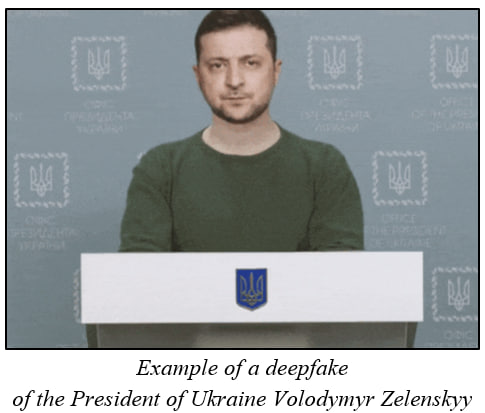
This video was of low quality and showed obvious signs of fabrication, which led to its rejection by the target audience. Its potential harmful effect was finally neutralised thanks to refutation by government officials.
After a certain period of «silence», the next prominent example of deepfake usage was the dissemination by russian information resources on November 7, 2023 (more than a year and a half after the fake video of the President of Ukraine) of a video of an alleged appeal by the former Commander-in-Chief of the Armed Forces of Ukraine Valerii Zaluzhnyi, calling on the citizens of Ukraine to come out to the streets of their cities and the military personnel to refuse to obey the «criminal orders» of the authorities. This video was promptly detected, analysed and debunked by the Center.
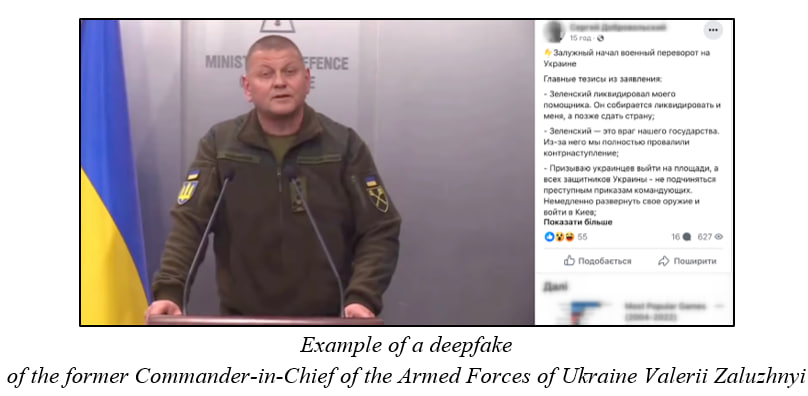
However, russia did not stop after the previous threat was neutralised. The very next day – November 8, 2023 – a new deepfake video appeared online, allegedly featuring V. Zaluzhnyi «refuting» the claim that the previous video from November 7 had been a deepfake. In this way, the enemy attempted to undermine the effect of Ukraine’s countermeasures. Nevertheless, this video was promptly debunked, preventing potential harm from its dissemination.
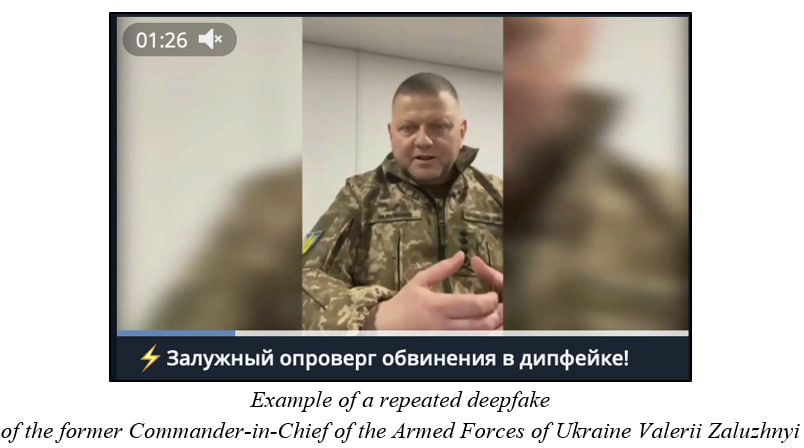
These videos significantly exceeded in quality the fake about the President of Ukraine, which indicated considerable advancement both in deepfake technology and the methods of its application. Despite this, the fabricated nature of the videos could still be identified without special knowledge or additional tools.
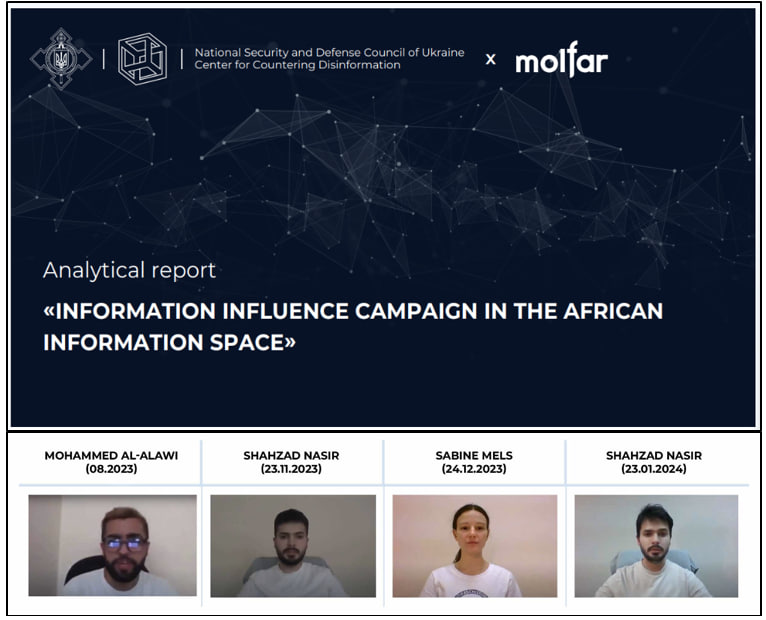
Similar cases of using higher quality deepfakes aimed at discrediting Ukrainian military and political leadership in the international information space between August 2023 and January 2024 were described in detail by the Center in the analytical report «Information Influence Campaign in the African Information Space», published on March 8, 2024.
Considering the above, it can be argued that the initial operations of the russian federation using AI-generated video content proved technically imperfect (despite improved quality in 2023-2024), were characterised by isolated «injections» and relied on the effect of surprise and a low level of media and digital literacy among both Ukrainian and international audiences. However, such attempts were unsuccessful – the target audience rapidly rejected them, and representatives of Ukraine, including the Center, promptly debunked these manipulations.
In 2025, the Center established that modern deepfakes have become significantly more advanced, and the strategy of their use shifted towards «contaminating» the information space. Instead of trying to make a wide audience believe a single fake, russian information operations now focus on undermining trust in information sources and provoking emotional exhaustion. However, as before, the main targets of discrediting are Ukraine’s military and political leadership and, most often, representatives of Ukrainian Defence Forces.
Thus, during the period from July to November 2025, the Center systematically detected materials created with the help of AI, in which the main «characters» were alleged representatives of the Defence Forces of Ukraine. The nature of these materials suggests that the main objective is to demoralise the personnel of the Defence Forces of Ukraine, undermine civilian morale, create an impression of supposed chaos, unprofessionalism and panic within the Defence Forces of Ukraine, as well as discredit decisions and actions of Ukraine’s military and political leadership, particularly among the international audience.
In addition, the Center’s observations indicate that russian propaganda uses two main approaches when creating video content using artificial intelligence technology and further disseminating destructive information influence:
1. Creating video content using deepfake technology and employing «actors» who imitate members of the Defence Forces of Ukraine, whose faces are overlaid with a «mask» and modified audio track.
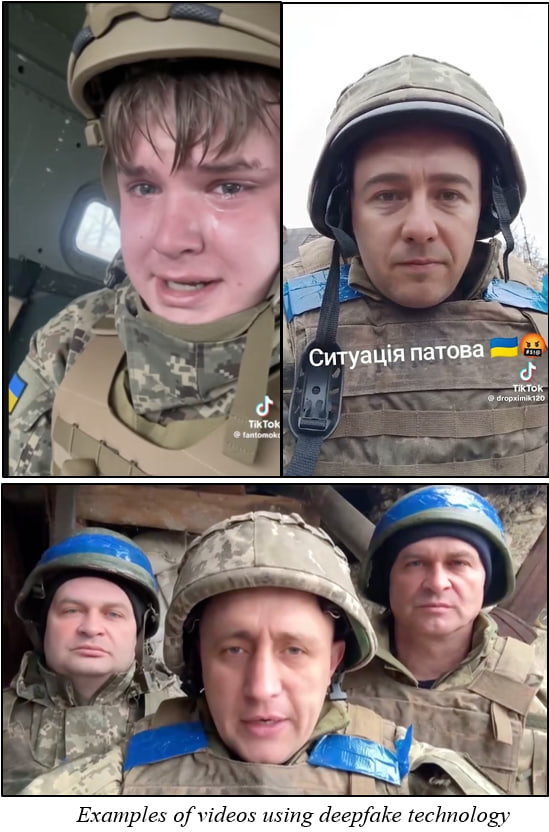
2. Creating video content allegedly featuring representatives of the Defence Forces of Ukraine, generated entirely with the help of artificial intelligence. Such videos are designed for rapid emotional engagement and mass dissemination.
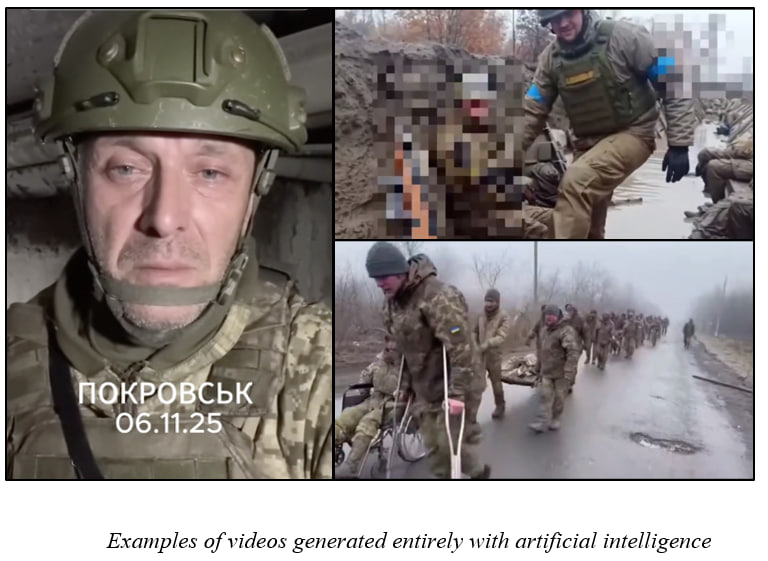
At the same time, the aggressor state uses a multi-level dissemination model for such content, covering key stages – from creating an anonymous account (usually on TikTok) and the primary «seeding» of content to its amplification through Telegram, X, and Facebook, and subsequent legitimisation by other resources, including russian networks of destructive information influence.
This approach is successful in terms of promotion, and the content is of high quality, which in some cases makes debunking impossible without additional verification tools. Meanwhile, such media materials gain trust from part of the audience, facilitating organic dissemination. However, despite the realistic appearance, they still contain signs of fabrication – in particular repeated elements: identical military patches, the same uniforms or identical faces. This indicates automated creation rather than authenticity, which allows debunking, although it requires more time and resources.
Mechanism for the dissemination of video content aimed at discrediting the Defence Forces of Ukraine and generated with the help of artificial intelligence[1]
Stage 1: Seeding and creating «credible» content
The first stage usually begins with the creation of an anonymous but military-stylised account on such social media platforms and applications as TikTok. The account serves as a «first-stage» or «seeding» platform for disseminating AI-generated videos.
These accounts publish a limited number of military-themed videos created using deepfake technology or fully generated by artificial intelligence. Such videos are generally aimed at discrediting the Defence Forces of Ukraine and the military and political leadership, creating an impression of alleged chaos and demoralisation within the Defence Forces of Ukraine, as well as undermining mobilisation processes.
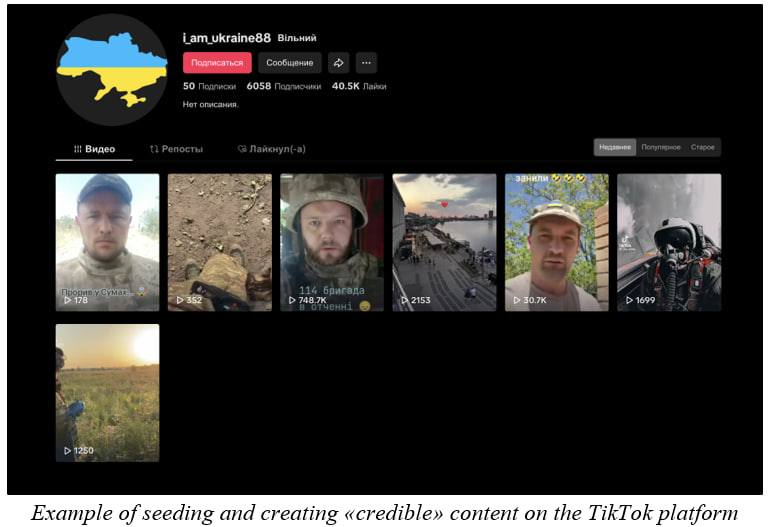
[1] The mechanism of dissemination is illustrated using the example of the TikTok account «@i_am_ukraine88».
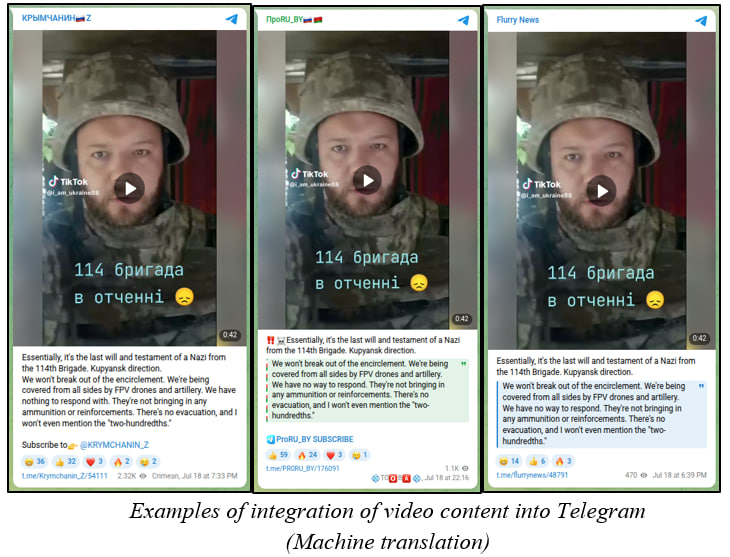
Stage 2: Integration of video content into Telegram, X and Facebook
After an AI-generated video is published on such applications as TikTok, it usually quickly gains a significant number of views, which increases the destructive informational impact of the content. Soon afterwards, such content spreads through Telegram channels and accounts on X and Facebook – this is the next stage of dissemination, which ensures broader reach and further legitimisation of fake materials.
It is important to note that at this stage the narrative is reinforced. A Telegram channel or an account on X or Facebook that disseminates a video generated with the help of AI usually does not limit itself to simple duplication but adds its own textual commentary, which significantly strengthens the main message. For example, what is presented in the video as «dissatisfaction» or «complaints» is transformed in the textual description into «direct threats of mutiny, refusal to perform combat missions, or accusations against the military command».
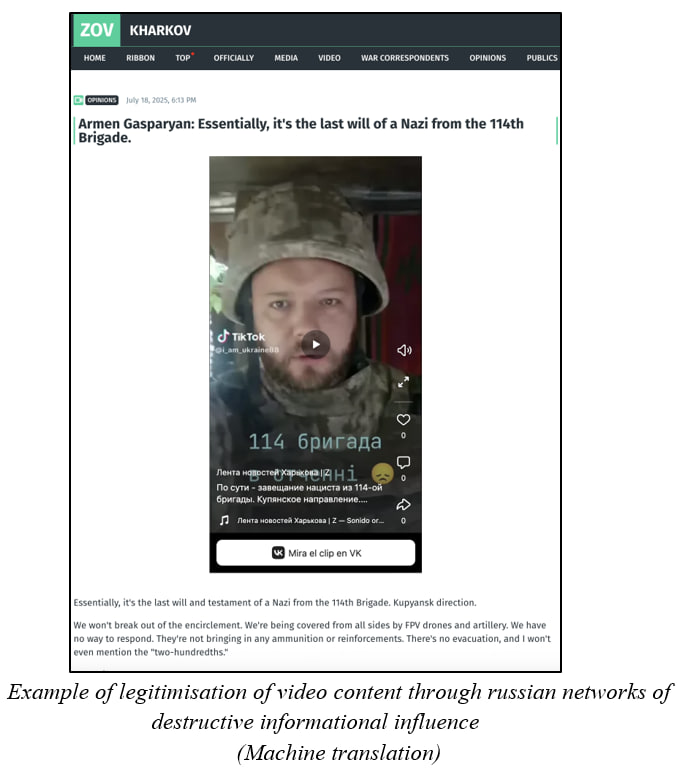
Stage 3: Legitimisation of video content through russian networks of destructive informational influence
At the final stage, the dissemination of AI-generated videos allegedly featuring representatives of the Defence Forces of Ukraine is typically supported by russian information influence networks, such as «Pravda» or «ZOV», which may include dozens or even hundreds of online platforms, as well as russian propagandists and military bloggers. Their involvement ensures mass dissemination of materials, gives them an appearance of «credibility», and reinforces their presence in the information space. The integration of the fake at this level transforms it from a category of «anonymous video from social media» into the format of an «official news item», which significantly increases its legitimisation among a wider audience.
Neutralisation of video content aimed at discrediting the Defence Forces of Ukraine and generated using artificial intelligence
Given the mechanism described above, cooperation with major technology platforms (BigTech) becomes strategically important, enabling rapid information exchange and facilitating the neutralisation of hostile information operations at early stages of their implementation. For the Center, one of the key areas of such cooperation is partnership with representatives of TikTok, the effectiveness of which has been confirmed in practice.
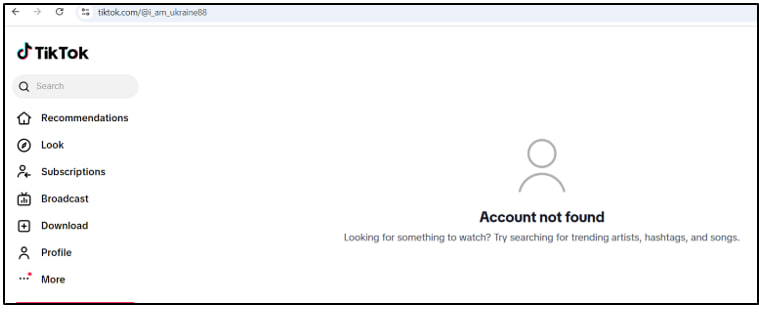
Thus, as a result of analysing videos and other materials published on the TikTok account @i_am_ukraine88, the Center established that artificial intelligence technologies were used to create them.
In particular, unnatural facial expressions, atypical blinking frequency, and minimal synchronisation of lip movements with speech were detected, which indicates the fabricated nature of the content.
In this regard, the Center transmitted information about the account to the TikTok administration. Subsequently, the TikTok administration decided to block it.
Conclusions
- Today, the use of artificial intelligence by the russian federation has evolved from isolated and ineffective deepfakes to an industrialised, cross-platform and psychologically adapted tool of hybrid warfare.
- The aggressor state actively uses deepfake and AI generation technologies to influence audiences, in particular by massively creating videos allegedly featuring representatives of the Defence Forces of Ukraine.
- AI-generated videos are disseminated through a multi-level model: from initial «seeding» on social media platforms such as TikTok to further amplification on Telegram, X and Facebook and «legitimisation» through propaganda networks, russian propagandists and military bloggers.
- The production and dissemination of such materials is intended to mislead the audience, create an «illusion of chaos», demoralise representatives of the Defence Forces of Ukraine and the civilian population, as well as undermine trust in the state’s military and political leadership, in particular among representatives of partner states. Therefore, this may contribute to destabilisation of the internal political situation in Ukraine and harm its image on the international stage.
- Due to measures taken by the Center and the TikTok administration, accounts that disseminate AI-generated videos are being neutralised. Such cooperation is an important step in preventing the dissemination of destructive content and minimising the impact of these information attacks.