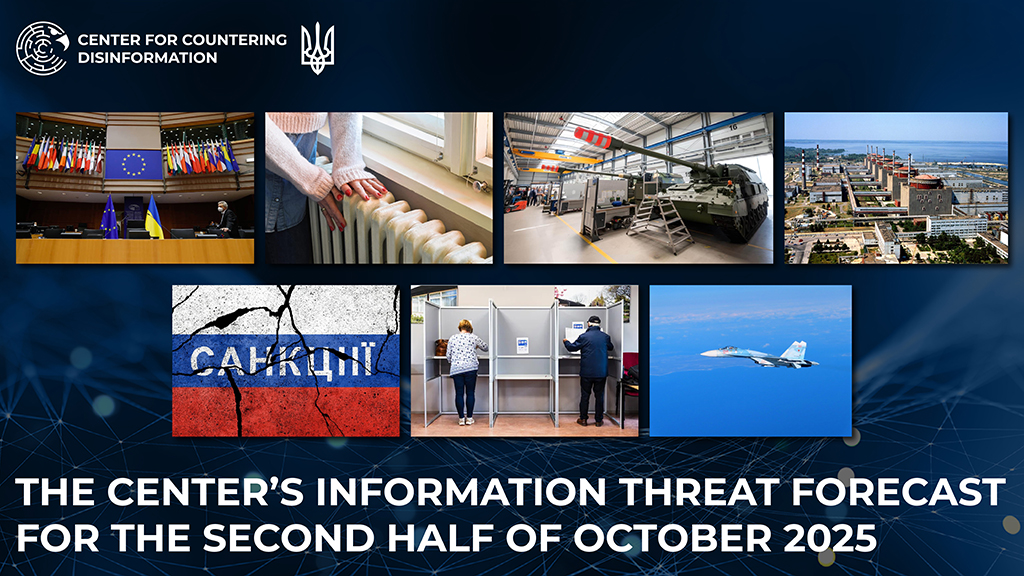
The Center’s Information Threat Forecast For the Second Half of October 2025
1. Information Campaign About Ukraine’s Alleged “Unpreparedness for Winter” and Inability to Resist russia
As the heating season approaches, the Center forecasts an intensification of the russian propaganda campaign tentatively titled “unpreparedness for winter.” Against the backdrop of strikes on Ukraine’s energy infrastructure, kremlin media will fuel panic about an allegedly catastrophic situation with energy supply and heating. Propagandists will disseminate dramatic forecasts about an “energy collapse,” “freezing cities,” “humanitarian catastrophe,” and “mass exodus of the population,” as well as Ukraine’s “inability to respond to energy attacks.”
Particular emphasis will be placed on discrediting the Ukrainian authorities through accusations of “incompetence,” “corruption in the energy sector,” and “inability to protect citizens.” Any technical problems or local disruptions will be presented as “evidence of systemic state failure.” At the same time, russian sources will try to create the impression that the “only solution” for Ukraine is capitulation and cessation of resistance in order to “save people from the cold winter.” The goal of the campaign is to demoralize the Ukrainian population, undermine trust in the government, and create pressure on international partners to pursue a “humanitarian resolution of the conflict.”
russian propaganda will actively spread messages about Ukraine’s alleged “powerlessness” and “inability” to deliver a symmetrical or asymmetrical strike on Russian energy facilities in response to attacks on Ukraine’s energy infrastructure.
The main tactic is manipulating statements by Ukrainian politicians.
In particular, it is expected that russian propaganda will manipulate President Volodymyr Zelenskyy’s remarks about a “blackout” in moscow, presenting them as an unfulfilled threat to sow doubt among Ukrainian society and international partners about Ukraine’s ability to respond.
2. Discrediting the 20th EU Sanctions Package
In connection with the expected adoption of the 20th sanctions package by the European Union, the Center forecasts an intensification of several information campaigns aimed at discrediting both the package itself and the mechanism of transatlantic coordination.
russian propaganda resources are highly likely to spread narratives about the “artificiality” of new sanctions and claim that the West has allegedly “run out of pressure tools.” The main emphasis will be on the “routine nature” of sanction policy and the supposed lack of real consequences for the economy of the rf. the kremlin will use statistical manipulation and selective economic data to demonstrate “stability” in industrial production and “record export figures,” presenting this as evidence of the failure of the sanctions strategy.
Attention is also expected to be focused on internal disagreements within the EU. Propagandists will emphasize the “resistance of certain states,” claiming that the sanction policy was allegedly imposed by Washington against the national interests of European countries. Fake reports about “secret consultations” or “behind-the-scenes pressure” by the United States on European partners to accelerate the adoption of the package may appear in the media space. It is also possible that there will be fabrications about alleged “internal opposition” among European business circles, which supposedly “demand an end to sanction escalation due to losses for companies.”
A separate block of propaganda will most likely focus on creating the illusion of a “reverse effect” of sanctions. russian media will spread messages claiming that sanctions have allegedly “hit Europe harder than russia,” and that their continuation constitutes “economic suicide” for the EU.
The overall goal of these campaigns is to weaken the unity of Western allies, undermine confidence in the effectiveness of sanction policy, and create grounds for internal discussions within EU countries about the “need to reconsider” the sanction course.
3. Manipulations Around the Situation at the Zaporizhzhia NPP and Promotion of the Narrative About “Ukrainian Nuclear Terrorism”
The Center expects the continuation of the russian information campaign aimed at discrediting Ukraine through accusations of “provoking a nuclear catastrophe” in the context of the power outage at the Zaporizhzhia NPP. Propagandists will continue to promote the narrative that it is the Ukrainian side that “systematically shells power lines,” preventing repair works to restore the plant’s external power supply.
At the same time, the kremlin will seek to conceal its own responsibility for the crisis — primarily the fact that it is the russian occupation forces who control the Zaporizhzhia NPP and block the possibility of full oversight by IAEA experts. Public statements will appear claiming that russia is allegedly “the only side preventing a catastrophe,” while Ukraine will be portrayed as “the source of nuclear terror.”
In parallel, russia will likely expand the disinformation campaign about “Ukrainian nuclear terrorism” beyond the Zaporizhzhia NPP. It is expected that messages about “Ukrainian drone attacks” on russian nuclear power plants or spent fuel storage facilities will spread. Such incidents, even fabricated ones, will be used to create the image of Ukraine as a “dangerous actor” allegedly violating international nuclear safety norms. the kremlin will seek to fuel global fears by invoking the “threat of another Chernobyl/Fukushima” to amplify anti-war and pacifist sentiments.
4. Intensification of “Anti-War” Rhetoric in European Countries
The Center forecasts an increase in informational pressure on European societies through campaigns cloaked in slogans “for peace” and “against war with russia.” In particular, the organization of “anti-war rallies” is possible, aimed at creating public pressure on EU governments to reduce or stop military support for Ukraine. Under the rhetoric of “defending peace,” arguments favorable to the kremlin are in fact being promoted.
Organizers or active participants in such actions are often pro-russian public figures, representatives of marginal political groups, or organizations linked to russian structures. russian state media systematically cover such events, presenting them as a “mass movement of Europeans against aid to Ukraine” and “evidence of division in society.”
The organization of new similar actions timed to important political events — an EU summit or the adoption of new sanctions or defense decisions — is possible. Such events may be coordinated through networks of activists affiliated with russian “anti-war movements” or organizations operating under the guise of “peace advocates.”
The primary goal of this campaign is to shake the internal unity of European states, sow doubt among citizens about the advisability of continuing support for Ukraine, and create an informational backdrop for pressure on political elites.
5. Campaign to Discredit Transatlantic Defense Cooperation
Amid discussions about the possible supply of long-range Tomahawk cruise missiles to Ukraine, the Center predicts an intensified information campaign aimed at discrediting initiatives to provide weapons to Ukraine and undermining transatlantic military cooperation. russian and pro-russian sources will systematically spread narratives claiming that the delivery of Tomahawks would have an “insignificant” or “illusory” impact on the course of the war.
At the same time, the storyline about “risks of escalation” and “NATO being drawn into direct confrontation” will be reinforced. kremlin officials and propagandists will emphasize that the supply of Tomahawks would enable strikes on targets inside russia, allegedly “crossing red lines,” threatening security relations, and “destroying ties” between moscow and Washington. This narrative will be accompanied by russian threats of “retaliatory strikes.”
The argument about limited U.S. weapon stockpiles is also expected to be actively used. russian and pro-kremlin sources will share figures about the remaining Tomahawk missiles in U.S. arsenals, emphasizing that their transfer to Ukraine would “deplete” stockpiles, make the U.S. vulnerable, and allegedly weaken allied defense capacity. This line aims to create the impression that providing weapons to Ukraine is supposedly disadvantageous for the West.
6. kremlin information campaign to discredit the EU decision on downing russian aircraft and drones in European airspace
The Center forecasts that in the second half of October, following the recent European Parliament resolution on the creation of a “drone wall” and the authorization to down russian aircraft and drones in European airspace, the kremlin will launch a large-scale information campaign opposing these measures. russian propaganda outlets are expected to promote narratives about the “aggressive policy of Europe,” the “relay of war,” and the “escalation of the conflict,” aiming to intimidate the European audience.
russian propaganda will attempt to sow doubts within European societies regarding the necessity and legitimacy of downing aircraft or “unidentified drones” over infrastructure facilities, thereby undermining support for defensive measures and generating internal tension within the EU.
The campaign aims to weaken Europe’s political will and reduce military support for Ukraine in its war against russia.
7. Hybrid influence operations ahead of parliamentary elections in the Netherlands
The Center forecasts intensified russian hybrid operations and disinformation campaigns ahead of the parliamentary elections in the Netherlands scheduled for 29 October. kremlin-controlled resources are expected to focus on supporting populist and Eurosceptic political forces opposing military assistance to Ukraine and advocating for the lifting of sanctions against russia. Propagandists are likely to disseminate narratives about the “economic losses” of the Netherlands due to its support for Ukraine, “security threats” linked to the presence of Ukrainian refugees, and the “loss of sovereignty” allegedly caused by EU and NATO membership.
Widespread use of social media is anticipated to influence various voter groups, spread disinformation about pro-European candidates, and artificially amplify divisive topics within Dutch society. russian propaganda will attempt to exploit the country’s socio-economic challenges, portraying them as consequences of a “flawed foreign policy” toward Ukraine. Special attention will be given to discrediting the incumbent government through messages about its alleged “submission to NATO interests” and “neglect of citizens’ needs.” The ultimate goal is to facilitate the success of political forces capable of altering the Netherlands’ stance on supporting Ukraine and undermining EU unity.