Forecast of the Center on information threats for the first half of June 2025
1. Ceasefire Negotiations and/or the End of the russo-Ukrainian War and the Discrediting of Ukraine
The Center forecasts an intensification of propaganda rhetoric related to negotiations concerning the russo-Ukrainian war. russian propaganda will target both Ukrainian and Western audiences.
In particular, for the Ukrainian audience, narratives are expected to spread suggesting that: Western countries are “betraying” Ukraine; They are either unwilling or unable to continue supporting Ukraine; There is no real backing for Ukraine among Europeans and Americans. For foreign audiences, the following narratives are anticipated: Ukraine allegedly wants to prolong the war as it allows the current government to avoid holding elections; Ukraine will lose anyway, so there is no point in continuing to support it; An increase in rhetoric around the ideas of a “common russian space” and framing the war as an “internal conflict of the russian people.”
Additionally, the spread of speculations about the so-called “illegitimacy” of Ukraine’s government is expected to intensify — portraying it as an authority with which peace agreements cannot be signed. Propaganda will also push demands for elections during wartime and other electoral-related speculations as a way to justify russia’s unwillingness to cease hostilities.
2. Intensification of Anti-Mobilization Narratives
As June 5 marks the deadline for repeated medical examinations (Military Medical Commission) for individuals previously deemed partially fit for military service, the Center forecasts an escalation of russia’s anti-mobilization information campaign in the days leading up to this date.
russian information outlets and anonymous Telegram channels are likely to disseminate videos showing violent detentions of men, along with fake reports of alleged beatings, torture, or deaths among mobilized individuals.
Such materials will be used by russia to create the illusion that such cases are widespread, aiming to incite panic and resistance. enemy is also expected to manipulate or selectively quote official statements in ways that cause confusion and misunderstanding regarding the legal and administrative aspects of the mobilization process.
The goal is to demoralize the population, foster an atmosphere of fear, undermine trust in Ukrainian institutions, and reduce the society’s mobilization readiness in wartime conditions.
3. Manipulations Surrounding G7 Ministers’ Meetings Ahead of the Summit
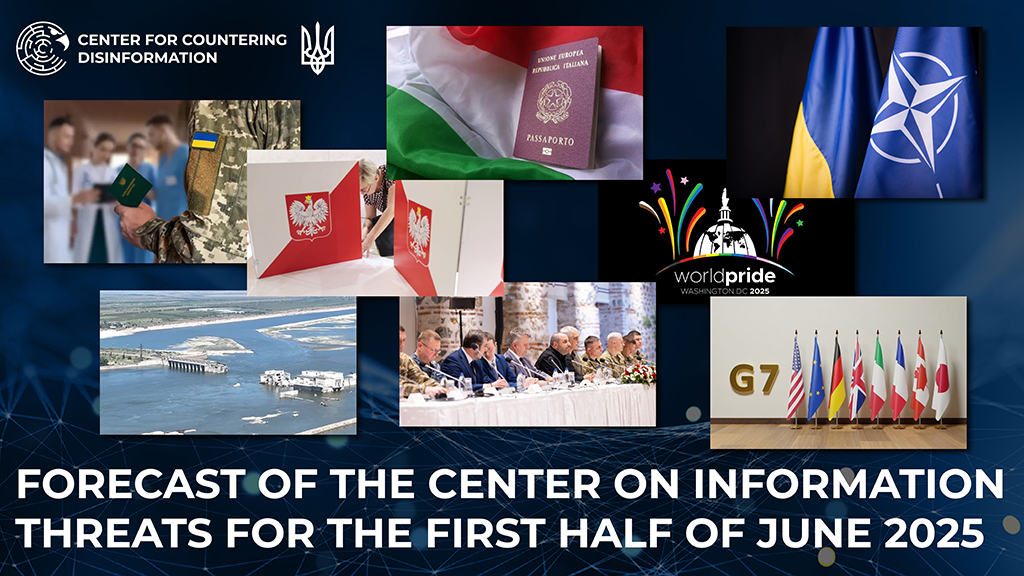
In the first half of June, an intensification of russian information operations is expected, aimed at discrediting the G7 countries and weakening support for Ukraine ahead of the G7 Summit, which will take place on June 15–17 in Canada.
The focus of this disinformation campaign will be on the meetings of G7 ministers held in preparation for the summit. Since support for Ukraine is traditionally a key topic at high-level international events, russian propaganda is likely to promote narratives such as an alleged “lack of unity among allies” regarding aid to Ukraine and the notion of “Ukraine fatigue.”
For the Ukrainian audience, the message that “the world has abandoned Ukraine” will be actively pushed. Through such narratives, russia aims to sow defeatist sentiments within Ukrainian society.
4. Manipulations Surrounding Preparations for the NATO Summit in The Hague
The NATO Summit annually attracts significant public attention, and therefore the Center forecasts that as early as the beginning of June, russia will intensify its information operations aimed at discrediting the Summit scheduled to take place in The Hague on June 24–25.
The main narrative will continue to be the claim of an alleged split within NATO regarding support for Ukraine and the Alliance’s inability to guarantee the security of its members and allies.
Additionally, russian propaganda will spread manipulations concerning Ukraine’s participation in the summit. There may also be an escalation of rhetoric from russia portraying Ukraine’s aspiration for Euro-Atlantic integration as the “primary cause” of the russian invasion.
5. russian manipulations amid the formation of a new EU Sanctions package
The Center forecasts an intensification of russia’s information operations aimed at discrediting the new European Union sanctions package being prepared following the recent approval of the 17th package. russian influence agents in Europe will increase efforts to obstruct the discussion and adoption of new sanctions, notably by spreading disinformation and manipulative narratives about their alleged ineffectiveness and harm to European countries.
Within russia’s domestic information space, rhetoric about the “ineffectiveness” of sanctions will intensify, alongside narratives promoting the idea that sanctions are “beneficial for the russian economy,” supposedly encouraging import substitution and stimulating the development of national production.
The overall goal of these information campaigns is to weaken sanctions pressure, fracture EU unity, and create the perception of the inevitable failure of anti-russian measures. kremlin-controlled media and pro-kremlin groups on social networks will be especially active in these efforts.
6. Accusations against Ukraine for the sabotage of the Kakhovka Hydroelectric Power Plant
On June 6, 2023, russian forces blew up the dam of the Kakhovka Hydroelectric Power Plant, causing a large-scale environmental disaster in southern Ukraine.
Ahead of the anniversary of the Kakhovka dam explosion, one of the largest man-made disasters resulting from the war, an intensification of russian information operations is expected, aimed at justifying russia’s actions and shifting the blame onto Ukraine.
russian propaganda may increase the spread of versions claiming a supposed “self-sabotage” or “Ukrainian provocation,” using pseudo-experts and manipulative technical “investigations.” Special attention will be paid to the English-speaking audience — social media campaigns involving bots may be deployed to sow doubts in Western societies about russia’s responsibility for the environmental catastrophe.
Within the domestic information space, kremlin will traditionally downplay or silence the scale of the disaster’s consequences, especially for the occupied territories of the Kherson region.
7. Manipulations and provocations during the second round of Presidential elections in Poland
On June 1, Poland will hold the second round of its presidential elections. The Center predicts an intensification of anti-Ukrainian propaganda inspired by russia, targeting Polish voters. russia will seek to amplify narratives about the “Volhynia massacre,” “Banderites,” and other anti-Ukrainian themes among Poles to maximize hostility toward Ukraine.
Additionally, ahead of the second round of the Polish presidential election, russian propaganda has begun spreading disinformation about alleged Polish preparations for provocations against belarus.
Specifically, propagandists claim that Polish security forces plan to disrupt the joint russian-belarusian military exercises “Zapad-2025,” scheduled to take place in belarus in September. They allege that Poland is developing provocations intended to cause casualties among the participants of the exercises. The spread of such fake news is likely aimed at destabilizing the situation in the country.
8. Manipulations during the referendum in Italy on simplifying citizenship acquisition for Non-EU Citizens
On June 8–9, Italy will hold a referendum on simplifying the procedure for obtaining citizenship for citizens of non-EU countries. Amid its preparation, russian influence agents may intensify efforts to incite interethnic and interreligious hostility to destabilize the country’s internal political situation.
Propagandists are likely to exploit far-right narratives, including claims of “loss of national identity,” “demographic displacement of Italians,” “encouragement of illegal migration,” and “artificial alteration of the electorate.”
These resources may amplify conspiracy theories suggesting that the reform is allegedly a “betrayal of national interests in favor of globalists” and “a step toward the loss of Italy’s sovereignty.” In this context, narratives about the “illegitimacy” of the referendum process or its “external control” may be promoted.
An increase in russian propaganda narratives aimed at discrediting Ukrainian citizens residing in Italy is also expected, along with attempts to turn Italian society against Ukrainian refugees.
9. Provocations During WorldPride 2025 in Washington
During the WorldPride 2025 event in Washington, there may be an increase in attempts by russian influence agents to destabilize the United States by inciting sociocultural conflicts.
russian propagandists may exploit sensitive topics related to the LGBTQ+ community to fuel narratives about a “targeted assault on traditional values,” “aggressive woke propaganda” by the Democrats, and the “marginalization of the Christian majority.” The goal of such information operations may be to deepen polarization within American society.
Outside the American information space, this topic may be used to hinder the spread of pro-European and pro-Western sentiments in Eastern European countries or to discredit the West a