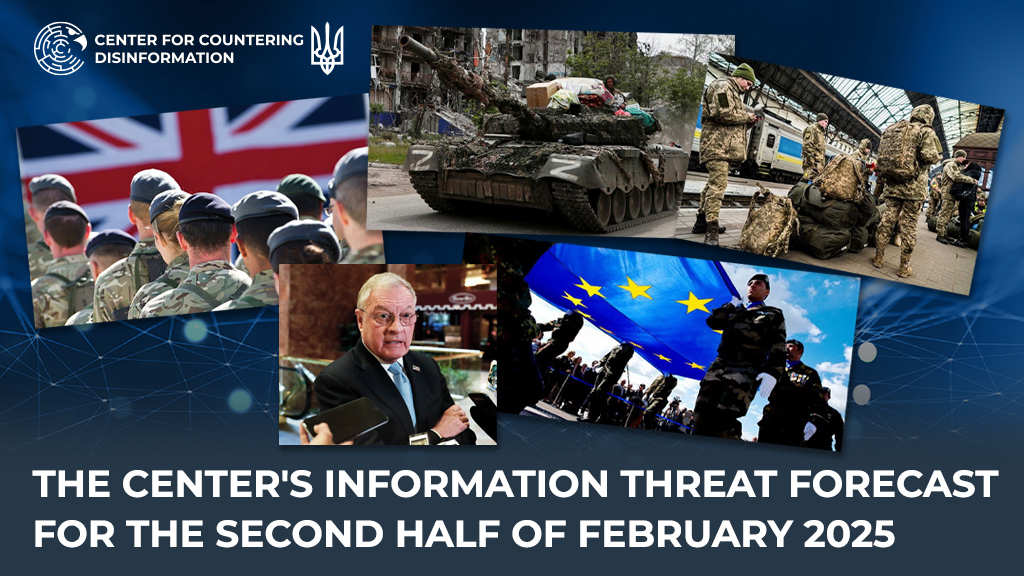
The Center’s Information Threat Forecast For the Second Half of February 2025
1. Intensification of Russia’s disinformation campaigns ahead of the third anniversary of the full-scale invasion of Ukraine
The Center predicts that Russia’s propaganda campaigns will intensify ahead of the anniversary of the full-scale invasion of Ukraine by Russian troops. It is expected that propagandists will intensify their efforts to justify the armed aggression against Ukraine and glorify its participants. It is expected that propaganda activities aimed at militarizing children and forming a vision of the war favorable to the Kremlin will take place in Russia and the occupied territories. These include “patriotic” lectures and films about the war, cultural events with the direct involvement of children, and so-called lessons of courage to which war veterans will be invited.
2. Discrediting Ukrainian-British relations in the context of the UK’s readiness to deploy its troops in Ukraine to ensure the implementation of any peace agreements
The Center predicts an intensification of Russia’s disinformation campaign regarding relations between Ukraine and the UK. It is possible that propagandists will intensify their attempts to discredit the agreement on 100-year partnership between Ukraine and the UK signed on January 16.
Russian propaganda will spread the narrative that Ukraine is allegedly losing its subjectivity and sovereignty and is turning into a “colony of the United Kingdom.” Allegedly, now the British will get Ukrainian subsoil and all mineral resources “for only three billion a year.” It is also possible that Russia will spread a narrative that it is thanks to access to Ukraine’s mineral resources that the UK government is ready to provide peacekeepers and thus allegedly consolidate its control.
The basis for this narrative will be manipulations around the content of the agreement, distortion of its provisions, and outright disinformation. In fact, the agreement does not contain any clauses that would require Ukraine to hand over its subsoil or the right to develop it to the UK. At the same time, the UK government is ready to provide peacekeepers to Ukraine to protect it from further aggression by Russia.
3. Russian propaganda attempts to spread the narrative that “there is no need to strengthen the EU’s defense capabilities” in the context of the Munich Security Conference
The Center predicts that amid the intensification of political dialogue on a peaceful settlement in Ukraine, which may involve a further increase in the role of European states in ensuring security on the continent, Russian agents of influence may spread narratives about the lack of urgent additional steps to strengthen the defense capabilities of EU countries.
This rhetoric is expected to intensify in the run-up to the Munich Security Conference, which took place on February 14-16 and is considered one of the key events for determining the future strategy of the EU and NATO towards Russia.
Russian propaganda and agents of influence will try to position the increase in defense spending as wasteful, and the US call for such actions as arrogance and disregard for the interests of European states. Russian propagandists are likely to intensify efforts to incite criticism of NATO and local governments that allegedly sacrifice the welfare of their populations to thwart phantom threats.
Russian propaganda is likely to spread narratives about Europe’s “military fatigue,” claiming that the time has come for a “realistic dialogue” on Moscow’s terms. The information activities of Russian agents of influence may also be aimed at normalizing attitudes towards Russia and Russian society in Europe. Emphasis may also be placed on economic difficulties in the EU and calls for “restoring favorable relations with Russia” to stabilize energy prices and restore trade.
4. Manipulations in the context of the visit of the US Special Envoy for Russia and Ukraine Keith Kellogg to the EU and Ukraine
The Center predicts that during the visit of the US Special Envoy for Russia and Ukraine Keith Kellogg to Europe and Ukraine, Russian propagandists may spread manipulative narratives that the United States is “giving up” Ukraine. Keith Kellogg’s visit could be portrayed as Washington’s pressure on European states and the Ukrainian government.
In addition, campaigns aimed at discrediting the US Special Envoy and spreading fakes about him in order to discredit the US representatives and delay the negotiation process are possible.
5. Manipulations around the negotiations to end the war in Ukraine, as well as accusations of deliberately fabricated crimes
The Center predicts that Russian propaganda will continue to spread manipulations around possible peace talks and US initiatives in this regard.
Through its manipulations, Russia will try to create the perception that Ukraine does not want to negotiate and deliberately disrupts them, that negotiations with Ukraine are “impossible,” and that continuation of the war is a “necessity.” The Center also predicts an increase in the spread of a hostile narrative about the alleged need for “great powers” to resolve issues without Ukraine’s participation. Despite Kyiv’s clear demonstration of readiness for a fair dialog, the Kremlin will continue to argue that it is the Ukrainian side that wants the war to continue. Amid a possible meeting between the American and Russian delegations in Saudi Arabia, the enemy will try to spread the narrative to the Ukrainian audience that Trump and Putin are deciding Ukraine’s fate without Ukraine, and that Trump is “giving up Ukraine to Putin.”
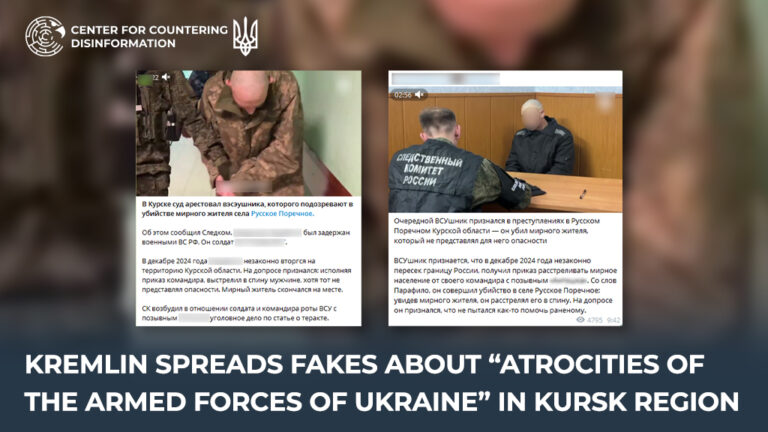
As part of this strategy, the Center also predicts an intensification of the disinformation campaign “atrocities of the Armed Forces of Ukraine.” The enemy’s propaganda will spread more fakes about the alleged crimes of the Ukrainian military as an argument against dialogue with Ukraine.
The disruption of the IAEA mission’s rotation at the Zaporizhzhya NPP may be part of a propaganda strategy to justify Russia’s refusal to negotiate with Ukraine. Russia systematically blocks the rotation of IAEA experts and then accuses Ukraine of doing so. In this way, Russia seeks to discredit our country, creating the perception in the eyes of the Western community that direct dialogue with Ukraine is allegedly impossible. Also, Russian propaganda uses manipulations on this issue to accuse Ukraine of prolonging the war.
6. Intensification of the disinformation campaign about the alleged territorial encroachment on Ukraine by its Western neighbors
The Center predicts that amid the start of negotiations to end the war, rhetoric about the alleged existence of territorial claims by neighbors and calls for the “division of Ukraine” may intensify. Russia systematically resorts to such information provocations. In this way, the aggressor state is trying to call into question the territorial integrity of Ukraine, the inviolability of borders in Europe and the legitimacy of internationally recognized agreements.
Therefore, in the context of the negotiation process to resolve the war, Russia is likely to try to shift the discussion from the need to restore Ukraine’s territorial integrity to the allegedly “historically just” seizure of “its territories” by Russia. Such rhetoric is also part of the Kremlin’s efforts to undermine diplomatic support for Ukraine and destabilize the situation in Europe.
7. Discrediting mobilization in Ukraine and the Ukrainian Defense Forces in order to weaken their actions
The Center predicts the spread of propaganda narratives related to the changes in the recruitment of men aged 18 to 24 for military service under contract introduced by the Ministry of Defense of Ukraine. It is possible that the Russians will widely promote the idea that this amendment is a “one-way ticket”. They will also spread the idea that the Ukrainian government “forgot about the military who have been fighting at the front since the beginning of the full-scale invasion of Russia” and classified them as “second-class” compared to contract soldiers aged 18-24.
The goal of this disinformation campaign is to discredit the conscription of Ukrainians under the age of 25 in order to reduce the combat potential of the Ukrainian Armed Forces.
Against the backdrop of this information campaign, Russian propaganda will spread narratives about the alleged successes of the Russian army, while emphasizing the “demoralization” of the Ukrainian military. At the same time, Russia is actively using conscripts in the war against Ukraine, despite official statements that they are not involved in hostilities. There is ample evidence that Russian conscripts are being sent to the front, sometimes under pressure or through forced “contract” service.