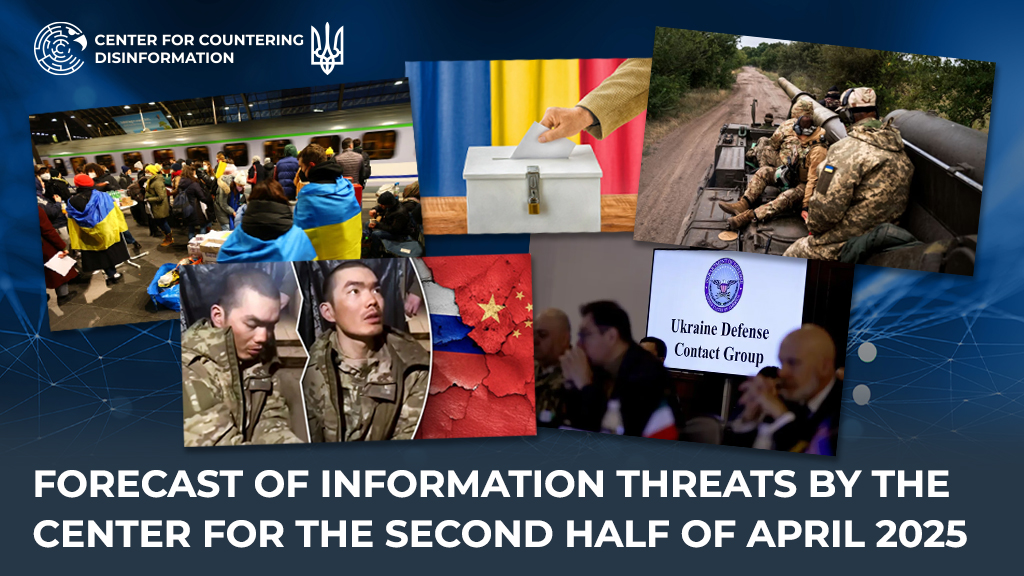
Forecast of information threats by the Center for the Second half of April 2025
1. Accusations against Ukraine of allegedly violating the ceasefire
The Center forecasts that russia will continue information operations aimed at discrediting Ukraine in the context of alleged violations of ceasefire agreements concerning energy infrastructure. New attempts by russia to provoke tensions between Kyiv and its partners are also likely, through false accusations that Ukrainian forces are striking gas transmission infrastructure.
This is how moscow seeks to portray Ukraine as a threat to European and Turkish energy security. In reality, it is russia that violates the ceasefire concerning energy infrastructure, and statements by kremlin officials about alleged Ukrainian strikes on russian energy sites have repeatedly been refuted by the General Staff of the AFU.
The main goal of russia’s disinformation campaign will be to shift responsibility onto Ukraine for violating the ceasefire, mislead international partners, and against the backdrop of its alleged willingness for peace justify continued strikes on Ukrainian infrastructure. russia aims to influence Ukraine’s partners and weaken Ukraine’s negotiating position.
2. Discrediting campaign regarding Chinese prisoners of war
The Center predicts that russian information resources and influence agents will likely continue to spread accusations that Ukrainian leadership is fabricating evidence of Chinese military involvement in the war against Ukraine.
russian propaganda may, in particular, question whether the soldiers captured by Ukrainian Defense Forces are actually Chinese citizens, promoting the narrative that the Ukrainian government is lying to the world.
3. Intensified campaigns about Western “fatigue” after the Ukraine Defense Contact Group meeting in the “Ramstein format”
Following the April 11 meeting of the Ukraine Defense Contact Group in the Ramstein format, the Center expects russia to ramp up its information operations against Ukraine and the West.
russian propaganda will likely focus on narratives of “Western fatigue with Ukraine,” “futility of military aid to Kyiv,” and “great damage to the EU economy” allegedly caused by assistance to Ukraine.
kremlin propagandists may also use the fact that U.S. Secretary of Defense Pete Hegseth did not attend in person to suggest a “collapse of the coalition” supporting Ukraine and claim that the U.S. “no longer backs” Kyiv.
Propagandists may push messages about a supposed lack of unity among European states regarding aid to Ukraine, and escalate disinformation aimed at foreign audiences about alleged corruption or misuse of Western aid by Ukraine.
In this way, moscow seeks to sow discord and doubt among Ukraine’s allies. By spreading messages that Ukraine can no longer count on continued support from Western partners, russia aims to demoralize Ukrainians and undermine their morale.
4. Discrediting the AFU and disinformation tied to russia’s new offensive
The Center forecasts that russia will intensify efforts to demoralize Ukrainians by distorting frontline data. This may include expanded disinformation campaigns about the situation in the Sumy and Kharkiv directions.
Amid narratives about an ongoing russian offensive, ru-propaganda will likely try to discredit Ukraine’s military leadership and sow panic among residents of border regions.
The enemy may also exploit the topic of the joint russian-belarusian military drills (“Zapad-2025”) to pressure Ukrainian society, in particular by promoting messages about a possible northern invasion and spreading fake news about “a second front” being opened from belarus.
5. Continued campaign to discredit mobilization in Ukraine, targeting Western audiences
russian propaganda continues to spread disinformation and manipulative messages about mobilization in Ukraine, especially via social media. The Center forecasts an intensification of this campaign, especially in English-language content aimed at audiences in the U.S. and other Western countries.
The goal is to create an illusion that Ukraine is “undemocratic,” “violating human rights,” that “Ukrainians don’t support their government’s policies,” and that they are “ready for peace on any terms.”
By pushing such narratives, russia aims to discredit the Ukrainian government in the eyes of the American public, halt military aid to Ukraine, and push Washington into conceding to the kremlin’s demands.
6. Escalation of propaganda in Europe ahead of Victory Day
russian state media are publishing archival materials highlighting the “atrocities of fascists and their collaborators.” Among them may be alleged testimonies collected by soviet security services about “atrocities” committed by Ukrainian and Baltic nationalist organizations that fought against soviet occupation.
These materials will be published to allegedly prove that Ukrainians, Lithuanians, and Estonians were “fascist nationalists,” and to undermine their contributions (and ours) to the victory over nazism in Europe.
In addition, kremlin propagandists are expected to intensify narratives about the supposed historical responsibility of all EU countries for starting World War II and to draw parallels with today’s events to intimidate Europeans with the threat of World War III.
7. Destabilization efforts in the Baltic States
russia will likely increase its information pressure on the Baltic States using themes like “historical memory” and the “desecration of soviet war memorials.” These narratives are already being accompanied by diplomatic protests and accusations of “vandalism” in connection with the removal of soviet monuments.
These narratives will be used to mobilize pro-russian groups, fuel interethnic tensions, and discredit the governments of Estonia, Latvia, and Lithuania as “undemocratic” and “russophobic.” Propaganda will also try to frame the actions of the Baltic States as “revenge” for the role of the Red Army in World War II. Tensions are expected to rise around war memorials and cemeteries ahead of May 9.
Information operations may also target religious issues. With the involvement of russian diplomats, russia accuses Estonia of “persecuting orthodoxy” following a new law requiring the Estonian orthodox church to cut ties with moscow.
Such campaigns may be part of hybrid operations against the Baltics. russia systematically uses the pretext of “protecting russian compatriots,” including against alleged religious persecution, to destabilize. An escalation of this rhetoric is expected following changes to Estonian legislation on the orthodox church.
8. Campaign against Ukrainian refugees in Europe
The Center forecasts that russia will intensify campaigns targeting Ukrainian refugees in Europe and the U.S. The goal is to undermine public support for Ukraine in Western societies, stir social tensions, and pressure governments to reduce aid to Kyiv.
This campaign is expected to include widespread dissemination of fake reports about alleged crimes committed by Ukrainians abroad. The involvement of foreign journalists, bloggers, and politicians loyal to russia is also possible.
One specific narrative — will focus on the supposed threat of “mass deportations” of Ukrainians from various countries. These narratives will attempt to portray Ukrainian refugees as a burden on Western societies — allegedly consuming resources, refusing to work, receiving privileges, and using protests to pressure local governments to support the war. kremlin propaganda is trying to turn Europeans and Americans against Ukraine.
9. Presidential elections in Romania
Ahead of the Romanian presidential elections in early May 2025, russian information resources and influence agents may escalate the dissemination of manipulative content about supposed “globalist” repression against Călin Georgescu, baseless claims of election fraud, and narratives suggesting that aid to Ukraine is a waste of money and harms Romania’s national interests.
10. russia will continue stirring unrest in Moldova ahead of parliamentary elections
russian media are portraying the detention of the head (bashkan) of the Gagauz autonomy, Yevgenia Gutsul, by Moldovan law enforcement as political persecution and an attack on freedom of speech.
Gutsul is known for her pro-russian views, and ahead of the parliamentary elections, she will likely rally anti-European voters.
Thus, ru-propaganda is interested in using her detention to deepen divisions in Moldovan society.