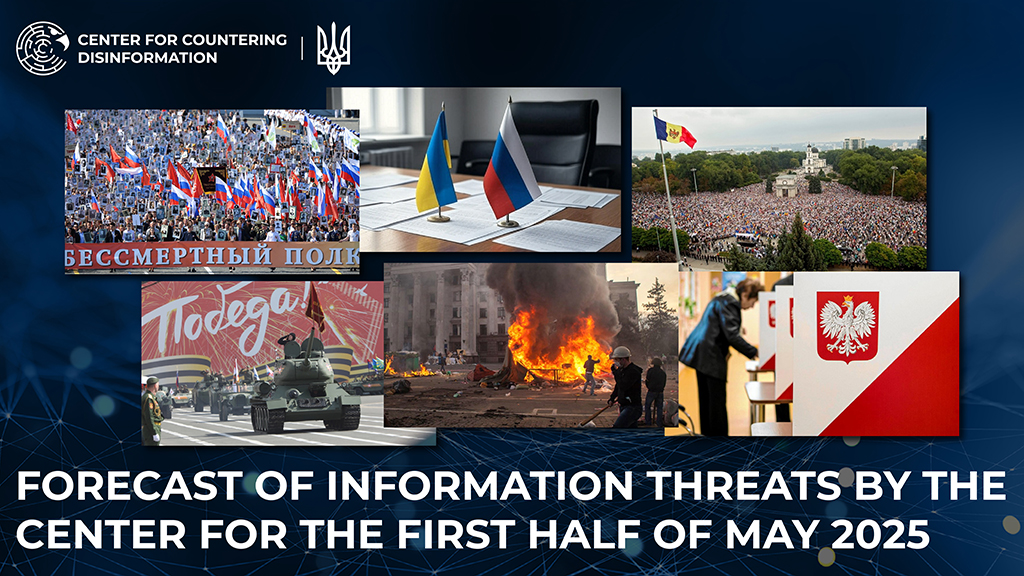
Forecast of information threats by the Center for the first half of May 2025
1. Disinformation campaigns about the negotiations
The Center forecasts that the campaign to accuse Ukraine of not wanting peace will continue. Narratives about Ukraine’s so-called non-negotiability are expected to spread, which allegedly deliberately disrupts the negotiation process.
It is assumed that the central theme of this campaign will be the occupied territories of Ukraine, which are allegedly russian, and failure to recognize this will be a key reason to accuse Ukraine of being a non-negotiator. Various narratives will be introduced into the Ukrainian information space, suggesting that Kyiv must recognize the occupied territories as russian to end the war, and promoting the idea that Ukraine needs “peace at any cost.”
It is also planned to spread disinformation about Ukraine’s “lack of independence” and its “dependence on Western curators,” primarily Britain and France. Allegedly, these states want a war with russia, so they are forcing Ukraine to continue fighting, disrupting the negotiation process.
Numerous russian information campaigns accusing the Ukrainian military of crimes they did not commit in order to distort reality and create the image of Ukraine’s lack of negotiating power are also possible.
2. Intensification of enemy information operations on the anniversary of the tragedy in Odesa
The Center forecasts intensification of russia’s information operations in late April – first half of May 2025, timed to the next anniversary of the tragic events in Odesa on May 2, 2014.
russian propaganda is likely to try to use this date for a large-scale campaign to discredit Ukraine, focusing on narratives about the alleged “mass murder of pro-russian activists” by “Ukrainian nazis.” The tragic fire in the House of Trade Unions will once again be presented as an “unforgettable crime” in which the Ukrainian authorities and law enforcement agencies are allegedly “covering up for the guilty.”
New fake “investigations,” “documentaries,” emotionally charged interviews, and manipulative visuals featuring footage of the tragedy are expected to appear. Special attention will be paid to attempts to mobilize an emotionally vulnerable part of the audience both inside and outside Russia, primarily in the countries of the Global South. An international campaign may be launched through English-language platforms to try to present the tragedy in Odesa as “proof of the criminal nature of the ‘Kyiv regime’.
The tragedy in Odesa will also serve as a pretext to intensify the spread of narratives about Odesa as an allegedly “russian city” and the need for the city to be occupied by russian troops.
3. Fakes dedicated to May 9 about how Ukrainians are “trampling on the great victory”
The Center forecasts intensification of russian information operations aimed at discrediting Ukrainian society on the eve of May 9, the date that Russian propaganda uses as a tool for the political cult of the “great victory.” It is expected that the key message of the campaign will be the narrative that “Ukrainians betrayed the memory of the Victory” by allegedly refusing to honor the heroes of World War II. Manipulations around decolonization and de-russification in Ukraine will be used as evidence of the truth of these theses. The thesis about “Ukrainians’ betrayal of the memory of the victory” will traditionally be presented by russia in conjunction with narratives about “nazism in Ukraine,” “degradation of morality” and “disregard for history.”
Fake news aimed at shaping the image of Ukrainians as people who are “cynical about their historical heritage” may intensify in the information space. On the other hand, manipulative messages are expected to spread that Ukrainians allegedly disagree with the state policy of abandoning the methods of commemorating the victory over nazism that are characteristic of russia. russian resources are likely to disseminate alleged “testimonies of ordinary citizens” who miss the “forbidden May 9”. This can be used to create the illusion of internal protest against the policy of decolonization in Ukraine.
It is also expected to promote the demolition of Soviet monuments, renaming of streets, and abandonment of Soviet symbols as examples of alleged “historical vandalism.” The campaign will be accompanied by the imposition of the image of the russian federation as the only “keeper of the true memory of the Victory” as opposed to Ukraine’s “betrayal” of these ideals.
Enemy propagandists are expected to pay increased attention to the events of May 9 in Kyiv, where EU foreign ministers will gather on Europe Day. The enemy’s propaganda will make great efforts to discredit this event, spreading fakes about the participants of the visit, about “nazis in Ukraine,” and so on. The enemy will contrast the meeting in Kyiv with the victory parade in moscow. russia will use the participation of politicians from some EU countries to provoke a split and destabilize Europe.
4. Propaganda for Victory Day abroad, in particular, about underestimating the role of the russian people in the victory over nazism
The Center forecasts that the russian side will intensify its information operations on May 9, focusing on the alleged “deliberate belittling of the role of the soviet (russian) people in the victory over nazism” by Western countries. As part of this campaign, russian propaganda will try to consolidate the image of russia as the main winner in World War II, whose role is “deliberately ignored or falsified” in the West.
russia is actively promoting the idea of the “genocide of the soviet people”, thus blurring the contribution of the peoples of all the republics that were part of the ussr to the fight against nazism and fascism; instead, it appropriates all the efforts to itself, because the “soviet people” in russian propaganda is equal to the “russian people”.
The narrative that the EU and the US are allegedly “rewriting history” by downplaying the contribution of the red army and exaggerating the role of the allies is expected to be actively promoted. Particular emphasis will be placed on demonstrations of “historical injustice,” such as canceling parades, dismantling Soviet monuments, or changing the format of victory celebrations in European capitals. These messages will be presented as examples of “russophobia” that has even affected the sacred topic of the “great victory” for russia, and the alleged return of the “Nazi” ideology in Europe.
5. Propaganda for the Victory Day in the temporarily occupied territories
russia’s information activity in the temporarily occupied territories of Ukraine is expected to intensify as May 9 approaches. As part of its information campaigns, enemy propaganda is likely to draw historical parallels between the “victory in the great patriotic war” and the current aggression against Ukraine, which the kremlin is trying to present as “a continuation of the fight against nazism.” Through such messages, russia seeks to legitimize the occupation by presenting it as “liberation” and the continuation of the “historical mission” of the USSR.
A large number of pseudo-patriotic events are expected to be held with the use of soviet symbols – “immortal regiment”, “lessons of courage”, rallies at monuments, meetings with veterans, etc. Children and young people will be especially actively involved: schoolchildren, students, and members of paramilitary youth organizations such as the “unarmy” or “the movement of the rirst”. Through such propaganda, russia is trying to form a common identity with russia in the minds of the population of the occupied territories based on the concept of a “great victory.”
6. russia’s information campaigns aimed at shaping the image of “aggressive Europe” as an element of justification for its own actions
russian information operations aimed at creating an image of Europe as an aggressor that is allegedly preparing for a large-scale war with russia are expected to intensify. Propaganda will continue to promote messages that strengthening the defense capabilities of European states allegedly poses a threat to russia. Such rhetoric is likely to become a central element of the narrative about russia being “surrounded” by enemies and the need for early counteraction.
The main goal of the campaign is to legitimize russia’s aggressive foreign policy, including the build-up of military presence near the borders with NATO, cyberattacks, and destabilization operations in the Baltic states, Poland, Slovakia, Finland, and other neighboring countries. In this way, the russian leadership seeks to present its own actions as “forced defense” and the EU and NATO’s security measures as an alleged provocation. The population’s fears of a possible world war will be actively exploited, with reference to Europe’s allegedly provocative actions and the “inevitability of a major conflict.”
Part of this campaign may include information operations to discredit the idea of foreign peacekeeping missions on the territory of Ukraine. In the russian information space, such actions will be called “occupation” or “intervention” and the military themselves will be called “aggressors” seeking to “seize resources.”
7. Presidential elections in Poland and intensification of information campaigns against Ukraine
On May 18, Poland will hold the first round of presidential elections. The Center forecasts that russia will intensify its information operations to destabilize the situation in the country and to shake up society within Poland as much as possible.
It is possible that such events will focus on manipulating sensitive historical Polish-Ukrainian events. It is predicted that russian propaganda will try to undermine support for Ukraine by spreading narratives about “war fatigue,” “the threat of being drawn into the conflict,” and “the privileged position of Ukrainians in Poland,” which can be used especially actively to mobilize the far right.
8. Destabilization in Moldova
The Center forecasts that russia will continue to attempt to undermine the internal political situation in Moldova. russian propaganda is expected to split Moldovan society along the lines of “authoritarian Chisinau – oppression of autonomous Gagauzia and unrecognized TMR”, “usurper Sandu – honest opposition politicians” and “fascist regime of Sandu – feat of the people of the USSR”.
The “immortal regiment” is scheduled to take place in Transnistrian cities on May 9, which can also become a convenient field for provocations. After all, in Moldova, the use of the St. George’s ribbon, a traditional attribute of the Victory Day celebration, has been banned since 2022.