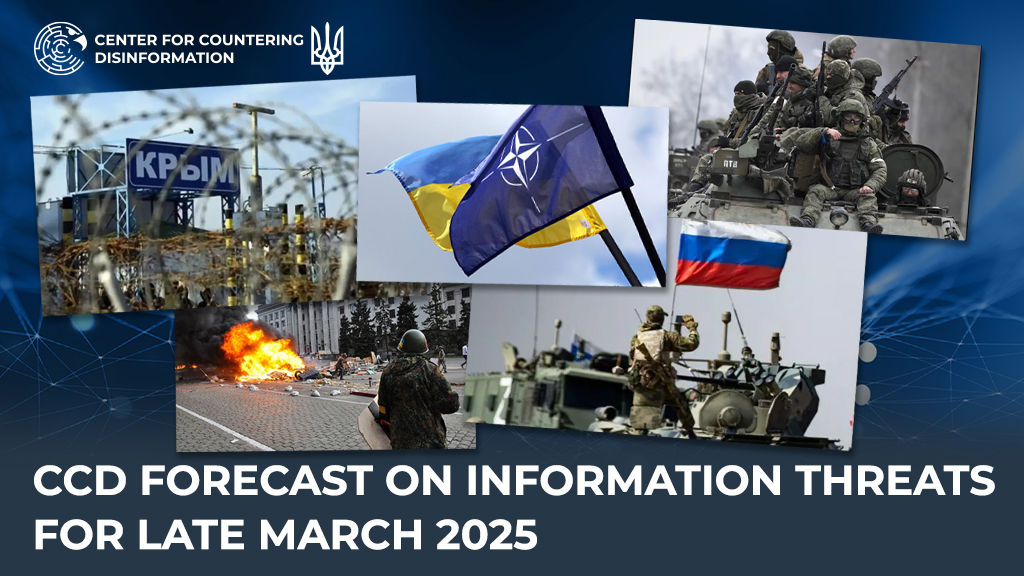
Center’s forecast on information threats for late March 2025
1. Discrediting the negotiation outcomes
Against the backdrop of negotiations between russia and the U.S. on a potential end to the war, an increase in russian disinformation campaigns aimed at discrediting the talks is expected. Through pro-russian media, the enemy will attempt to inject messages into the Ukrainian information space that undermine Ukraine’s willingness to accept a 30-day ceasefire and frame it as an opportunity to allegedly prepare for “new acts of aggression against russia.”
Additionally, russian propaganda is expected to attempt to divide Ukrainian society by spreading fake claims that members of Ukraine’s delegation, which participated in negotiations with the U.S. in Saudi Arabia, secretly agreed to a “capitulation” and “betrayal of Ukraine’s interests.” Such manipulations aim to mislead the Ukrainian public about the nature of the negotiations and discredit their results.
Furthermore, efforts to push narratives that discredit the mobilization process and service in Ukraine’s Defense Forces are expected to intensify.
At the same time, an increase in ru-propaganda rhetoric—especially from russian officials—aimed at downplaying European partners’ support for Ukraine is anticipated. This is intended to maximize demoralization within Ukrainian society.
2. Possible “false flag” provocations by russia blaming NATO
russian presidential aide and former fsb chief nikolai patrushev has claimed that NATO is allegedly planning terrorist attacks against russian cargo ships, tankers, and pipelines. russia may use such accusations as a cover for its own special operations in waters near EU countries, aiming to blame Ukraine and NATO for these incidents. Such accusations will be used to push the narrative that Ukraine and NATO seek to prolong the war.
Additionally, russia could use such provocations to reinforce the propagandist claim that NATO is at war with russia in Ukraine and is preparing for aggression against russia. The target audiences include: russian citizens (to mobilize public support for a “war against NATO”), foreign states (to spread the notion that russia is a “peaceful” nation forced to defend itself against an aggressive Alliance).These provocations could also serve as a pretext for hostile actions against Finland, which patrushev has labeled a “new staging ground for aggression against russia.”
3. Disinformation campaign to legitimize the occupation of Crimea
On March 18, russia plans to mark the 11th anniversary of Crimea’s annexation. A series of events and celebrations are scheduled on the peninsula to legitimize russia’s occupation of Crimea. For example, on March 17, numerous events will take place in Simferopol to commemorate the so-called “reunification of Crimea with russia.”
The Center anticipates an increase in rhetoric about “returning the peninsula to its native harbor” and “Crimea being forever part of russia,” aimed at bolstering patriotic sentiment within russia. The main focus will be on justifying the so-called “referendum” and manipulating historical narratives.
Additionally, from March 22 to 28, an International Scientific and Diplomatic Congress will be held in Livadia, Crimea, to mark the 80th anniversary of the Yalta Conference of Allied States. The Center predicts that russia will use this congress to legitimize Crimea’s occupation in the eyes of the international community by promoting narratives of the peninsula as “historically russian territory” and a site of international dialogue.
It is also likely that the kremlin will exploit the concept of a new “Yalta order,” attempting to promote the idea of a new “world partitioning between great powers” in russia’s favor.
Simultaneously, russia may accuse Ukraine of “distorting history” and attempt to portray it as a Western puppet. moscow is also expected to seek support from the Global South for its concept of a “multipolar world.”
4. Escalation of disinformation on alleged “atrocities by Ukraine’s Armed Forces” in kursk region
The Center anticipates an intensified disinformation campaign about alleged “atrocities by Ukraine’s Armed Forces in Kursk region.” A surge of fake reports about alleged killings of russian civilians by Ukrainian soldiers is expected.
ru-propaganda seeks to create the image of a “russian Bucha.” Propagandists may use this disinformation to justify the full-scale invasion as “necessary” and to deflect attention from documented crimes committed by russian forces against Ukrainian civilians.
This large-scale campaign aims to discredit Ukraine and undermine its international support amid ongoing negotiations.
5. Renewed disinformation about the Odesa tragedy (May 2, 2014) to discredit Ukraine
russian propaganda is expected to intensify disinformation about the May 2, 2014, tragedy in Odesa, when 47 people died in a fire at the Trade Unions House.
For over a decade, russia has exploited this event to push anti-Ukrainian narratives and destabilize the situation in the city. Propaganda falsely portrays it as a deliberate mass killing of pro-russian activists by “ukrainian nazis.”
russia continues using this tragedy as justification for its military aggression against Ukraine, portraying itself as the “defender of russian speakers.”
The Center anticipates an intensified campaign to destabilize Odesa, particularly ahead of the tragedy’s anniversary. russian propaganda will likely exploit the recent murder of activist Demian Ganul, portraying it as a “justified act of revenge” or evidence of an “underground pro-russian movement” in Odesa.
These narratives could be used to intimidate the city’s population, justify sabotage operations, and incite new provocations ahead of May 2.
6. ru-propaganda’s attempts to demoralize Ukrainians with disinformation about the frontline situation
The Center forecasts an intensification of information operations in which hostile propaganda will attempt to push distorted data about the frontline situation to the Ukrainian audience in order to incite panic among civilians and undermine the morale of the military.
Hostile propaganda will seek to exaggerate russian achievements on the frontline while simultaneously creating the illusion of a “catastrophic” situation for Ukrainian forces.
At the same time, narratives suggesting that the Ukrainian Armed Forces’ command is allegedly concealing the truth about the frontline situation may be promoted. In this way, the enemy aims to create divisions within Ukrainian society and provoke public pressure on the government to make concessions to russia in negotiations. It is likely that as part of this campaign, hostile propaganda will continue attempts to erode trust in the government and stir discontent in society by discrediting mobilization efforts.
7. Intensifying efforts to justify russia’s military presence in Syria
Amid ongoing armed clashes in western Syria, russian influence agents are likely to spread narratives advocating for a continued russian military presence in the region.
Recently, for the first time since the fall of Bashar al-Assad’s regime in December 2024, russian arabic-language accounts on X have begun sharply criticizing current leader Ahmad al-Sharaa, while actively promoting russian military bases like Hmeimim as safe havens for civilians.
These materials are most likely being used to spread positive associations about russia among the population of the region and to justify the necessity of russia’s presence in Syria as a guarantor of stability and security for religious minorities. The Center forecasts the continuation of russian informational activity aimed at these goals.8. russia’s information support for Sudan’s Armed Forces
The Center forecasts that, against the backdrop of the military successes of the Sudanese Armed Forces in the war against the Rapid Support Forces (RSF), russian officials and influence agents will intensify efforts to shape the image of russia as an ally of the government forces and will criticize the Rapid Support Forces, portraying them as a proxy of the collective West despite the lack of convincing evidence of RSF support by European states.
In reality, however, RSF is likely receiving assistance from the United Arab Emirates, while the government forces are supported by Iran and Egypt. At the same time, russian propagandists will most likely remain silent about the role of the Wagner PMC in supporting RSF.
Despite the fact that russia has assisted both sides of the conflict at different times, the kremlin may attempt to present itself as a guarantor of stability in Sudan.
9. Intensification of russia’s information operations aimed at destabilization in the Baltic region
The Center forecasts that russia will intensify propaganda at the end of March aimed at destabilizing the situation in the Baltic states. On March 27-28, a conference titled “The Status of russian Compatriots in the Baltic Region Countries” will be held in russia’s kaliningrad. Among the participants will be the well-known kremlin propagandist maria butina.
This event will serve as a platform for spreading propaganda narratives about the “discrimination” and “oppression of rights” of russians in the Baltic states. The kremlin has traditionally used the topic of “russian compatriots” as a convenient tool for destabilization and pressure on its neighbors.
Thus, russia is attempting to disguise its aggressive policies and interference in the internal affairs of neighboring states under the pretense of “protecting human rights.”