Does the Russian influence strategy work in the Baltic countries?
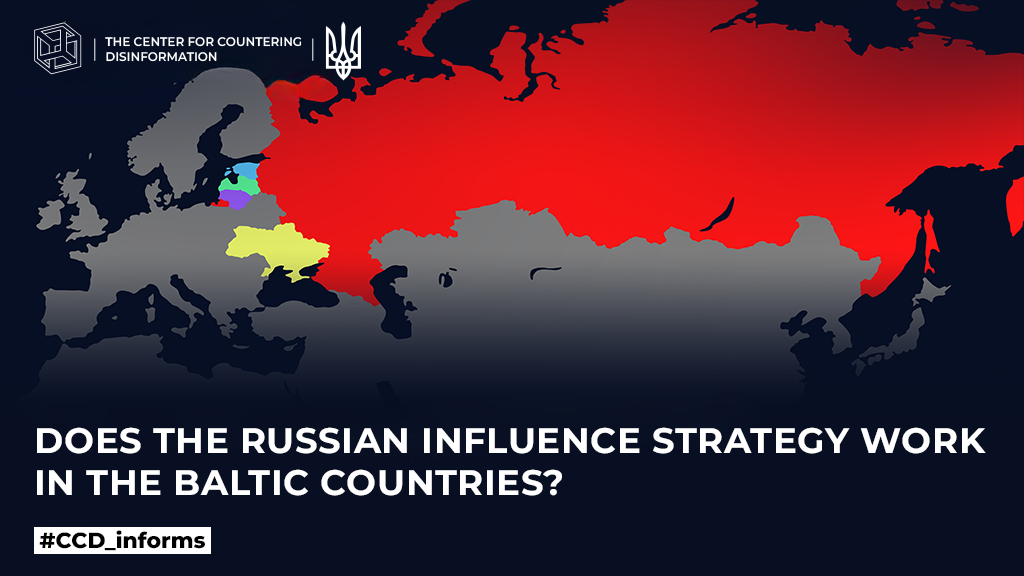
Against the backdrop of military failures in Ukraine, the kremlin is seeking vulnerabilities within the countries of the Baltic region, targeting the weaknesses of the North Atlantic Alliance. Journalists from various international publications have gained access to documents that prove russia has been implementing a long-term strategy of “soft power” to strengthen its influence in Estonia, Latvia, and Lithuania since 2021. Separate strategies have been developed for each Baltic country, outlining specific goals and timeframes for their implementation (2022, 2025, and 2030).
The analyzed Kremlin document is titled “Strategic Goals of the russian federation in the Estonian, Latvian, and Lithuanian Directions.” The investigation was conducted jointly by journalists from publications such as “Dosye,” Delfi Estonia, LRT, Expressen, Norddeutscher Rundfunk, Frontstory.pl, Süddeutsche Zeitung, VSquare, Westdeutscher Rundfunk, Yahoo News, and Re:Baltica.
According to their findings, the strategy was developed by the Department for Transborder Cooperation of the russian Presidential Administration.
Of course, the kremlin’s plans take into account the specificities of each Baltic country, but there are also common positions.
Yes, the russians intend to establish a network of controlled organizations for “relationship restoration” in the Baltic countries. To implement this plan, in addition to the russian-speaking population, Baltic businessmen are being encouraged with promises of access to the russian market. One of the main goals of the strategy is to prevent the militarization of these countries, hinder the strengthening of NATO’s influence in the region, and prevent the establishment of new NATO military bases on their territory. Other priorities include curbing support for the russian opposition, preserving the maximum presence of the russian language in education and society, maintaining a “common historical memory,” and promoting “historical” symbols of russia. Journalists previously became aware of similar kremlin strategies aimed at annexing Belarus by 2030 and transforming Moldova into its satellite.
How realistic are these tasks?
Given the geopolitical situation that has arisen following russia’s invasion of Ukraine, the kremlin’s calculation of improving political and economic relations with the Baltic states is highly unrealistic. The war has completely overturned the political, economic, and humanitarian situation and severely limited russia’s influence in the region. Currently, Estonia, Latvia, and Lithuania are known for having the most critical stance towards the kremlin’s foreign policy within the entire European Union. As a result, moscow is increasingly drifting away from the realization of its plans regarding the Baltic countries.
Former Estonian President T. Ilves, commenting on the strategy, noted that the kremlin is “disconnected from reality and does not understand what is happening in the Baltic countries.” Moreover, only a small portion of russia’s political elite believes in the possibility of returning the Baltic countries to the russian sphere of influence. Since 2021, the implementation of the strategy has been progressing according to a scenario unfavorable for the kremlin, and many of its points have already failed.
Indeed, after the full-scale invasion of Ukraine, the participation of the Baltic countries in NATO actions in support of Ukraine and the implementation of anti-russian sanctions has intensified. Currently, Latvia has significantly reduced the presence of russian interests and its allies in the economic and information space, making the likelihood of russia’s influence on Latvia’s chosen political course negligible. Hopes for support for kremlin ideas among the russian-speaking population have also proven to be exaggerated. On April 29, a picket against russia’s interference in Latvia’s internal politics took place near the russian Embassy in Riga, organized by the society “russian Voice of Latvia.” Its chairman, M. Levushkan, condemned russia’s attempts to influence russian-speaking residents of the country.
The kremlin’s plans for the development of “soft power” in Lithuania were even more modest, as its recent leaders held the most critical position on russia’s foreign policy among the neighboring Baltic countries. The attempts by putinists to weaken russophobic sentiments and strengthen Eurosceptic views in Estonia through local russians proved futile. Although some politicians from the Center Party (the main opposition force in Estonia) continue to repeat the Kremlin’s propaganda slogans even after the invasion of Ukraine, their numbers are not sufficient to influence the overall situation.
However, despite the failure of the first stage of the strategy, the kremlin will not abandon its attempts to bring the Baltic countries back into its sphere of influence.
In the fall of 2023, another kremlin project called the “Baltic Platform” is scheduled to begin, which will serve as a new base for agents of influence in Europe under the guise of advocating for the protection of the Baltic Sea’s ecology. The project’s moderators intend to manipulate environmental issues and simulate catastrophic future scenarios. The focus is on gaining support for the project from pro-russian parties and individuals with dual citizenship (non-citizens).